Want to feel the rumble of your favorite movies and music? This guide dives deep into how to improve bass on your home theater sound box. We’ll explore speaker placement, equalization, adding a subwoofer, and even simple room acoustic tricks to make your sound truly immersive. Get ready for a bass experience that shakes things up!
How to Improve Bass on Home Theater Sound Box
Ever watched an action movie and felt like something was missing? That thumping explosion, the deep rumble of an engine, or the impactful beat of a song – it’s all about the bass. If your home theater sound box isn’t delivering that satisfying low-end punch, don’t worry! There are plenty of ways to improve bass on your home theater sound box and transform your audio experience. Think of it like adding extra flavor to your favorite meal; the right bass makes everything more exciting and immersive.
This isn’t just about making things louder. It’s about achieving a richer, more defined, and impactful bass response that makes you feel like you’re right in the middle of the action. Whether you’re a movie buff, a music lover, or a gamer, great bass can elevate your entire entertainment setup. Let’s dive into the strategies to get you feeling that rumble.
Key Takeaways
- Speaker Placement is Crucial: Where you put your main speakers and subwoofer significantly impacts bass response.
- Subwoofer Integration: A dedicated subwoofer is often the most effective way to achieve powerful, deep bass.
- Equalization (EQ) Adjustments: Fine-tuning your audio settings can boost bass frequencies without distortion.
- Room Acoustics Matter: The shape and furnishings of your room affect how bass waves behave.
- Check Connections: Ensure all your speaker wires and subwoofer cables are securely connected.
- Consider Bass Traps: These specialized acoustic treatments can help tame boomy bass and tighten the sound.
- Upgrade Your Speakers: If your current speakers lack bass potential, an upgrade might be necessary.
📑 Table of Contents
The Foundation: Understanding Your Current Setup
Before you start tweaking, it’s essential to understand what you’re working with. What kind of speakers do you have? Are you using just your TV’s built-in speakers, a soundbar, or a full surround sound system? Each setup has different limitations and potentials when it comes to bass.
Assessing Your Sound Box
Your “sound box” can refer to a few different things in a home theater context: it could be your main speakers, your soundbar, or even the collective system including a subwoofer. For this guide, we’ll cover improving bass for a range of home theater setups.
Identifying Bass Woes
Are you experiencing no bass at all, or is it muddy and undefined? Do you get some bass, but it just doesn’t have the “oomph” you’re looking for? Knowing the specific problem helps you choose the right solution. For example, muddy bass might need acoustic treatment, while weak bass might require adding a subwoofer or adjusting speaker settings.
Strategic Speaker Placement for Maximum Bass Impact
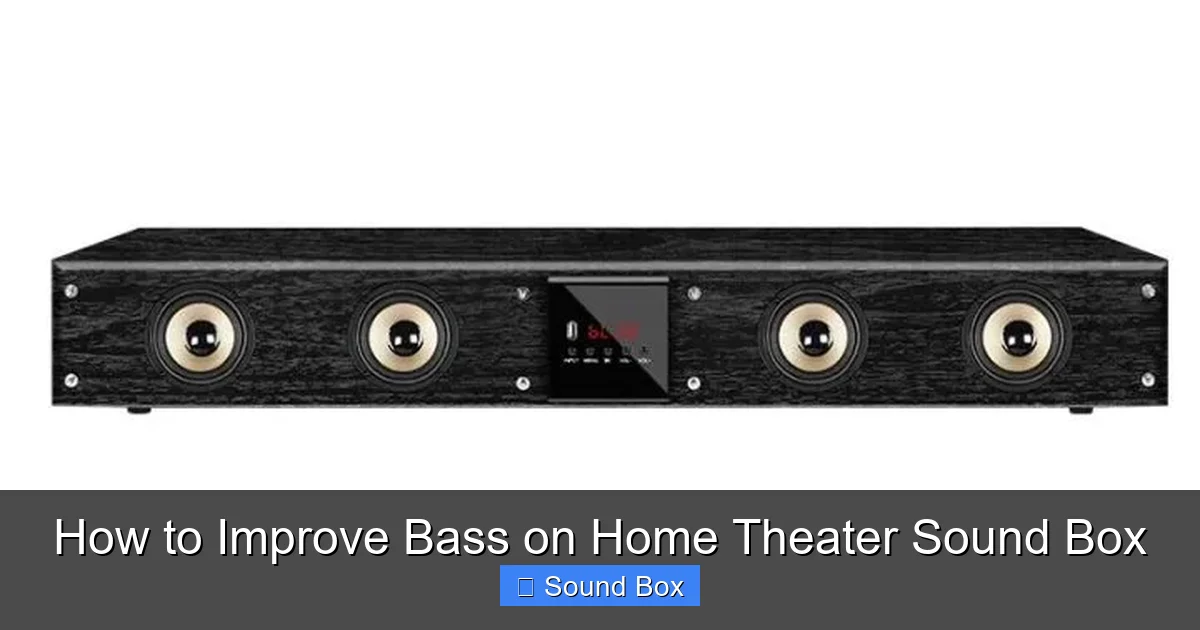
Visual guide about How to Improve Bass on Home Theater Sound Box
Image source: img.drz.lazcdn.com
Where you place your speakers is one of the most critical, yet often overlooked, factors in achieving good bass. Bass frequencies are long waves that interact with your room’s surfaces. Correct placement can amplify them, while incorrect placement can cancel them out or create uneven booming.
Main Speaker Placement
For traditional stereo or surround sound systems, the position of your front left and right speakers is paramount.
- Corner Placement: Placing speakers in corners can often boost bass output because the walls reinforce the low frequencies. However, this can sometimes lead to boomy, less controlled bass. Experiment to see if it works for your room.
- Distance from Walls: Pulling your speakers away from the walls can help reduce boomy bass and provide a clearer soundstage. Try placing them at least a foot or two away from the back and side walls.
- The “Subwoofer Crawl”: This is a fantastic trick specifically for subwoofers. Place your subwoofer in your main listening position. Then, crawl around the room at the subwoofer’s height, listening for where the bass sounds the best and most balanced. Mark that spot, and then place your subwoofer there. This helps you find the room’s “sweet spot” for bass.
Subwoofer Placement Nuances
If you have a dedicated subwoofer, its placement is even more crucial. Subwoofers are designed to produce those low frequencies that smaller speakers can’t handle, and their position can dramatically alter your bass experience.
Soundbar Positioning
If you’re using a soundbar, especially one with an integrated or separate wireless subwoofer, placement is still important.
- Front Soundstage: Position the soundbar directly in front of your TV, ideally at ear level, for the best overall sound projection.
- Subwoofer Location for Soundbars: Most wireless subwoofers included with soundbars are designed to be somewhat flexible. However, avoid hiding them in cabinets or behind furniture, as this can muffle the sound. Experiment with placing it near the front of the room, possibly in a corner, to see how it affects the bass.
Remember, these are starting points. The ideal placement will depend on your room’s layout and your specific listening habits. Don’t be afraid to experiment!
Leveraging Equalization (EQ) and Audio Settings

Visual guide about How to Improve Bass on Home Theater Sound Box
Image source: images.nexusapp.co
Most modern audio receivers, soundbars, and even smart TVs have built-in equalization (EQ) settings that allow you to tailor the sound to your preferences. This is a powerful tool for improving bass.
Understanding EQ Presets
Many systems offer presets like “Movie,” “Music,” “Bass Boost,” or “Treble Boost.”
- “Bass Boost” or “Loudness”: These presets are designed to artificially increase the perceived bass levels, especially at lower volumes. Use them with caution, as they can sometimes make the bass sound unnatural or distorted if overdone.
- “Movie” Mode: This often emphasizes certain frequencies to enhance cinematic experiences, which can include a bass boost.
Manual EQ Adjustments
For more precise control, use the manual EQ settings. This typically involves a graphic equalizer with sliders for different frequency ranges.
- Boosting Low Frequencies: Focus on the lower bands, usually from 60Hz up to about 120Hz. A small boost (2-3dB) in this range can make a noticeable difference.
- Avoiding Distortion: Be careful not to boost too much, as this can lead to muddy, distorted, or boomy bass. If you hear distortion, reduce the boost.
- Subwoofer Level Adjustment: If your system has a separate subwoofer level control, start with it at the 50% mark and adjust it by ear. You want the subwoofer to blend seamlessly with your main speakers, not overpower them.
If you’re connecting your TV to a soundbar or a separate speaker system, ensure the audio output settings on your TV are configured correctly. For instance, on your TV, you might need to set the audio output to “External Speakers” or “HDMI ARC” to send the best audio signal. For more in-depth information on improving sound quality in various setups, check out this guide on how to connect TV to Bluetooth speaker for amazing sound.
The Power of a Dedicated Subwoofer

Visual guide about How to Improve Bass on Home Theater Sound Box
Image source: img.lazcdn.com
If your current setup relies solely on your TV speakers or a soundbar without a subwoofer, adding one is arguably the most significant upgrade you can make for powerful bass. A subwoofer is specifically designed to reproduce low-frequency sounds, which are essential for that immersive feeling.
Types of Subwoofers
- Passive Subwoofers: These require a separate amplifier to power them. They are less common in home theater setups nowadays.
- Active (Powered) Subwoofers: These have their own built-in amplifier and are the most common type for home theaters. They simply plug into your receiver or soundbar and a power outlet.
- Wireless Subwoofers: Many modern soundbars come with wireless subwoofers that pair easily with the main unit.
Integrating a Subwoofer
- Receiver Connection: If you have an AV receiver, it will likely have a dedicated “Sub Out” or “LFE” (Low-Frequency Effects) port. Connect this port to the LFE input on your subwoofer using a subwoofer cable.
- Soundbar Connection: If your soundbar supports an external subwoofer, it will have a specific connection method, usually via RCA cable or a wireless pairing process.
- “Crossover” Setting: Your subwoofer and receiver/soundbar will have a crossover setting. This determines the frequency at which the main speakers stop producing bass and hand it over to the subwoofer. A common starting point is around 80Hz for smaller satellite speakers, but it should be adjusted to best match your speakers. Consult your speaker and subwoofer manuals for recommendations.
Adding a subwoofer can dramatically change how you experience movies and music. It allows your main speakers to focus on mid-range and treble, leading to clearer sound overall, while the subwoofer handles the deep lows. For those looking to enhance sound for specific events, understanding how to improve sound quality for outdoor parties can also involve bass considerations.
Taming Room Acoustics for Cleaner Bass
Your room itself plays a massive role in how bass sounds. Hard surfaces reflect sound waves, while soft surfaces absorb them. This interaction can lead to boomy, uneven bass or make it sound thin and weak.
Understanding Bass Waves
Bass frequencies have long wavelengths. They can interact with room dimensions and furniture in complex ways.
- Room Modes: These are standing waves that occur at specific frequencies due to the dimensions of your room. They can cause certain bass notes to sound excessively loud while others are almost inaudible.
- Reflections: Bass waves bounce off walls, ceilings, and floors. Too many reflections can make bass sound muddy.
Acoustic Treatment Solutions
- Soft Furnishings: Carpets, rugs, thick curtains, and upholstered furniture can all help absorb bass frequencies and reduce reflections, making the bass sound tighter and more controlled.
- Speaker Placement Revisited: As mentioned earlier, moving speakers and your listening position can significantly impact room modes. Experiment with different placements.
- Bass Traps: These are specialized acoustic panels designed to absorb low-frequency energy. Placing bass traps in the corners of your room is often the most effective way to control boomy bass. While they can be an investment, they can make a night-and-day difference.
- Room Shape: Irregularly shaped rooms tend to have less problematic bass issues than perfect rectangles. If your room is a perfect cube, you might have more challenges.
If you’re setting up speakers for a more intimate gathering or even a small party, understanding how to position speakers for best sound can involve similar acoustic principles on a smaller scale.
Checking Connections and Cables
It might seem obvious, but loose or faulty connections are a common culprit for weak or distorted bass.
Speaker Wire Integrity
- Secure Connections: Ensure your speaker wires are securely connected to both your amplifier/receiver and your speakers. For binding posts, make sure the wire is firmly clamped. For banana plugs, ensure they are fully inserted.
- Wire Gauge: For longer runs or higher-powered systems, using the correct gauge speaker wire is important. Thicker wire (lower gauge number) is generally better for carrying the audio signal with less loss. For typical home theater setups, 14 or 16-gauge wire is usually sufficient. If you need to run wires through walls, consult guides like how to run speaker cable in walls for proper installation.
- Polarity: Make sure your speaker wires are connected with the correct polarity (+ to +, – to -). Incorrect polarity can cause bass cancellation.
Subwoofer Cable
- LFE/Subwoofer Cable: Use a dedicated subwoofer cable (often labeled LFE) for connecting your subwoofer to your receiver. These are designed to carry low-frequency signals effectively.
- Cable Condition: Ensure the cable is not damaged and is securely plugged in at both ends.
A simple check of all your connections can sometimes be the easiest fix to improving bass.
When to Consider Upgrading
Sometimes, no amount of tweaking can overcome the limitations of your existing equipment. If you’ve tried everything else, it might be time to consider an upgrade.
Speaker Limitations
Small satellite speakers or TV speakers simply aren’t designed to produce deep, powerful bass. If your system lacks a dedicated subwoofer and your main speakers are small, you’ll likely hit a ceiling on bass performance.
Subwoofer Upgrades
If you already have a subwoofer but aren’t satisfied, consider upgrading to a larger or more powerful model. Different subwoofers excel in different areas – some are designed for very deep extension, while others offer more punch and speed.
Considerations for a New System
When looking at new sound systems, pay attention to the specifications for bass response (often measured in Hertz, with lower numbers indicating deeper bass) and the presence of a dedicated subwoofer. Features like what features to look for in home cinema sound can guide you towards systems that prioritize excellent low-end performance. If you’re just starting, researching how to set up a Bluetooth speaker for best sound at home might lead you to systems that already incorporate good bass.
Conclusion
Improving the bass on your home theater sound box is a journey of understanding your equipment, your room, and how sound interacts. By strategically placing your speakers, carefully adjusting EQ settings, considering the addition of a subwoofer, and paying attention to your room’s acoustics, you can unlock a much more satisfying and immersive audio experience. Don’t underestimate the power of small adjustments; they can make a huge difference. So, go forth, experiment, and enjoy the rumble!
Frequently Asked Questions
Why does my home theater bass sound muddy?
Muddy bass is often caused by too much low-frequency energy in your room, reflections off hard surfaces, or an improperly integrated subwoofer. Try adjusting subwoofer placement, adding soft furnishings like rugs or curtains, or exploring acoustic treatments like bass traps.
How do I make my existing speakers produce more bass?
While small speakers have inherent limitations, you can try adjusting EQ settings to boost bass frequencies. Strategic placement, especially near walls or corners, can also sometimes enhance bass output, but be mindful of potential muddiness. For significant improvement, adding a dedicated subwoofer is usually the best option.
What is the “subwoofer crawl” and how does it help improve bass?
The subwoofer crawl is a method to find the best listening spot for your subwoofer. You place the subwoofer in your main listening position, play bass-heavy audio, and then crawl around your room at the subwoofer’s height. Where the bass sounds the most balanced and impactful is where you should place your subwoofer.
Should I use “Bass Boost” on my home theater system?
“Bass Boost” or similar features can enhance perceived bass, especially at lower volumes. However, use them cautiously. Overuse can lead to distorted, boomy, or unnatural-sounding bass. It’s often better to achieve good bass through proper speaker placement and equalization.
How important is the crossover setting on my subwoofer?
The crossover setting is crucial for seamlessly integrating your subwoofer with your main speakers. It determines the frequency point where your main speakers stop producing bass and hand it over to the subwoofer. Setting it correctly ensures that you don’t have a gap or overlap in frequency response, leading to a more unified sound.
Can I improve bass without buying a subwoofer?
Yes, you can make improvements without a subwoofer by optimizing speaker placement, adjusting EQ settings to boost lower frequencies, and addressing room acoustics to reduce muddiness. However, the deepest and most impactful bass requires a dedicated subwoofer.