Yes, most record players need an amplifier to power speakers, as they don’t produce enough signal on their own. Think of an amplifier as the volume knob and power booster for your music.
Hey there, fellow music lovers! Ever spun a vinyl record and wondered why the sound is so quiet, or why you can’t get those speakers to really sing? It’s a common puzzle, especially when you’re just getting into the wonderful world of turntables and great audio. We all want that rich, immersive sound that only vinyl can provide, whether it’s for jamming out to your favorite albums, setting the mood for a movie night, or just chilling with some background tunes.
Sometimes, it feels like there are a million little boxes and wires to connect, and you just want to listen to your records without a degree in audio engineering! It can get confusing pretty fast, right? You’ve got your shiny new turntable, some cool speakers, and then… what? Do they just plug into each other? That’s where this guide comes in. I’m here to break down exactly why your record player might be a bit shy on volume and how an amplifier or receiver can be your best friend in getting that sound just right.
We’ll go through everything step-by-step, keeping it super simple. No jargon, no confusing tech talk. Just clear, friendly advice to get your vinyl sounding its absolute best. Ready to make your music loud and proud? Let’s dive in and uncover the secrets of record player sound!
Let’s Talk About Sound: The Tiny Signal From Your Vinyl
So, why can’t your record player just plug straight into those awesome speakers and make a ruckus? It all comes down to the tiny, tiny electrical signal that the turntable actually creates. Imagine your record player as a super sensitive listener. The needle (or stylus) glides through the grooves of your vinyl. As it moves, it vibrates. These vibrations are converted into a very, very weak electrical signal.
This signal is so weak, it’s like a whisper. Your speakers, on the other hand, need a much louder signal to actually move their cones and create the sound waves we hear. They’re like singers who need a microphone and a sound system to project their voice to a whole crowd. The turntable’s signal is just too small for the speakers to notice, let alone amplify into room-filling music.
The Magic of Amplification: Giving Your Music a Voice
This is where the amplifier, or sometimes called a receiver, comes into play. Think of it as the superhero that takes that tiny whisper from your record player and turns it into a booming, clear voice that your speakers can use. An amplifier’s main job is to boost that weak signal. It takes the electrical signal, makes it much stronger, and then sends it to your speakers.
Without this boost, your speakers would just sit there, quiet and sad. The amplifier is the crucial link that makes the whole system work. It’s not just about making things louder, though. A good amplifier also helps to shape the sound, making sure it’s clear, balanced, and sounds the way the artist intended. It’s the heart of your audio setup!
Do All Record Players Need Amplifiers? The Exceptions
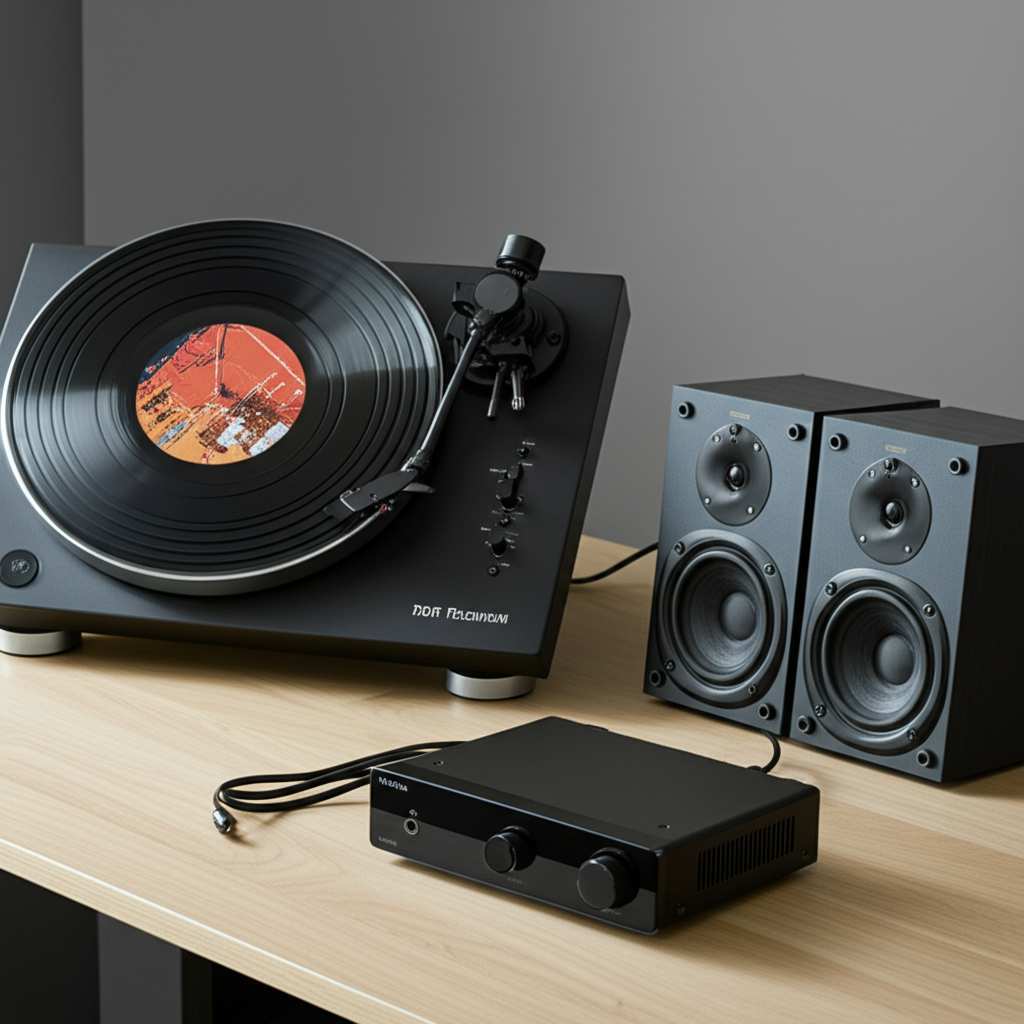
Now, you might be thinking, “Max, are there any record players that don’t need an amp?” Great question! The answer is yes, there are a few special cases. Some modern turntables come with a built-in amplifier, and some even have built-in speakers! These are often called “all-in-one” or “plug-and-play” record players.
These all-in-one units have everything tucked inside: the turntable mechanism, a small amplifier, and even speakers. You just plug them into the wall, put on a record, and you’re good to go. They’re super convenient for beginners or for small spaces. However, the sound quality from these integrated systems might not be as rich or powerful as a setup with separate components.
Another type of record player that might not need a separate amplifier is one that has a built-in phono pre-amplifier. We’ll talk more about phono pre-amps in a bit! But if your turntable has one built-in, it might be able to connect directly to some powered speakers.
Understanding the “Phono” Signal: A Special Kind of Whisper
Let’s get a little more technical, but don’t worry, we’ll keep it simple! The signal coming directly from your turntable’s cartridge is called a “phono signal.” This signal is not only very weak but also has a specific EQ curve called the RIAA equalization curve. This curve boosts the bass and cuts the treble during recording to fit more music on the record and reduce surface noise.
To get the music sounding natural again, this EQ curve needs to be reversed. This is where a “phono pre-amplifier” comes in. It does two main jobs:
1. Boosts the signal: It takes that super weak phono signal and makes it much stronger, turning it into a “line-level” signal.
2. Applies RIAA equalization: It reverses the EQ curve, making the bass less boomy and the treble less sharp, so the music sounds balanced and full.
Most standard amplifiers and receivers have a dedicated “Phono” input on them. This input has a built-in phono pre-amplifier that handles both the boosting and the EQ correction. So, if your turntable doesn’t have a built-in phono pre-amp, you’ll need to plug it into the Phono input of an amplifier or receiver.
The Role of the Phono Pre-Amplifier: Your Sound’s First Helper
So, what exactly is this phono pre-amplifier, and why is it so important? Think of it as your music’s very first coach. When the needle reads the record, it’s creating a signal that’s incredibly delicate. This signal needs to be handled with care. A phono pre-amp is specifically designed to handle this delicate signal.
It boosts the signal from millivolts (mV) to volts (V). That’s a huge jump! It also applies that RIAA equalization we talked about. Without this pre-amplification and equalization, the sound you’d get would be incredibly quiet, tinny, and lack any bass. It would sound like a distant radio with a blown speaker. The phono pre-amp is essential for making that vinyl groove translate into listenable audio.
Connecting the Dots: How It All Fits Together
Here’s a common setup you’ll see:
Record Player: This is where the magic starts.
Phono Pre-Amplifier: This can be a separate box, built into your turntable, or built into your amplifier/receiver.
Amplifier/Receiver: This boosts the signal further and provides the power to your speakers.
Speakers: These produce the sound you hear.
If your record player has a built-in phono pre-amp, you can often connect it to a regular AUX input on an amplifier or even directly to powered speakers. Powered speakers have their own amplifier built-in. If your record player doesn’t have a built-in phono pre-amp, you must plug it into the Phono input on an amplifier or receiver that has one.
Types of Amplifiers and What They Do
When we talk about amplifiers for your record player, you’ll usually encounter a few main types:
Integrated Amplifiers
These are like the all-rounders of the audio world. An integrated amplifier combines a pre-amplifier (which controls volume and tone) and a power amplifier (which boosts the signal for the speakers) into a single unit. Many integrated amps also have a built-in phono input, making them a fantastic choice for a vinyl setup. You connect your turntable (if it doesn’t have its own phono pre-amp) to the phono input, and then connect your speakers to the amplifier.
Receivers
A receiver is very similar to an integrated amplifier, but it adds a radio tuner (AM/FM) to the mix. So, you get amplification for your turntable, CD player, streaming devices, and you can listen to the radio. Many receivers also come with phono inputs. They are a great way to consolidate multiple audio sources into one component.
Power Amplifiers
These are just the power-boosting part of the equation. They don’t have volume controls or input switching. You’d typically use a power amplifier in conjunction with a separate pre-amplifier. For most beginners, an integrated amplifier or a receiver is usually the more practical and common choice.
Powered Speakers
These are speakers that have an amplifier built directly into them. This means they don’t need to be connected to a separate amplifier or receiver. If your turntable has a built-in phono pre-amplifier, you can often connect it directly to powered speakers. This is a simple, minimalist setup.
Do My Speakers Need Power Too? Passive vs. Active
This is a key point that often confuses people! Speakers themselves come in two main flavors:
Passive Speakers
These are the most common type. They don’t have any built-in amplification. They require an external amplifier (like an integrated amp or receiver) to send power to them so they can produce sound. This is why your record player needs an amplifier to drive these passive speakers.
Active Speakers (Powered Speakers)
As mentioned before, these speakers have their own amplifier built right inside. They plug into a power outlet and receive a line-level audio signal. If your turntable has a phono pre-amp, you can often connect it directly to active speakers. This is a neat, simple setup, but remember, the turntable still needs that phono pre-amp stage to boost and EQ the signal correctly before it goes to the active speakers.
Let’s Look at the Connections: What to Plug Where
Understanding the different types of inputs and outputs can make setting up your system much easier.
Common Record Player Outputs:
RCA Cables: These are the most common way your turntable sends its audio signal. You’ll usually see a pair of red and white RCA connectors.
Ground Wire: A thin, often bare wire that helps reduce humming or buzzing noises. This usually connects to a “Ground” or “GND” terminal on your amplifier.
Common Amplifier/Receiver Inputs:
PHONO Input: This is specifically for turntables that don’t have a built-in phono pre-amp. It has the necessary circuitry to boost and EQ the phono signal. It usually has RCA jacks and a ground screw.
LINE-LEVEL Inputs (AUX, CD, TAPE, etc.): These are for devices that already output a boosted, equalized signal (like CD players, streamers, or turntables with built-in phono pre-amps). You cannot plug a standard turntable directly into these.
Powered Speaker Input: If you’re using powered speakers, they’ll have their own power cord and audio input jacks (often RCA or 3.5mm).
Speaker Outputs (on Amplifiers/Receivers):
Binding Posts or Spring Clips: These are where you connect your passive speakers using speaker wire.
Can I Plug My Record Player Directly into My Computer Speakers?
This is a question I get a lot! Generally, no, you can’t plug a standard record player directly into most computer speakers. Here’s why:
1. No Phono Pre-amp: Computer speakers are designed to receive a line-level signal, not the weak phono signal from a turntable.
2. No Power for Passive Speakers: If your computer speakers are passive (less common for computer speakers, but possible), they won’t have the power to drive them anyway.
3. Lack of Grounding: You’ll likely get a persistent hum without a proper ground connection.
However, if your record player does have a built-in phono pre-amplifier, and your computer speakers are powered (meaning they have their own amp), you might be able to connect them. You’d use the line-level output from your turntable (often a switch on the back to choose between “Phono” or “Line”) and connect it to the audio input on your powered computer speakers. You might still miss out on some sound quality compared to a dedicated hi-fi system, but it can work for casual listening!
A Quick Look at Phono Pre-Amplifier Options
Let’s break down where you can find this essential phono pre-amplification:
| Source of Phono Pre-Amplifier | Description | Pros | Cons |
| :—————————- | :——————————————————————————————————— | :———————————————————————————————— | :———————————————————————————————————- |
| Built into Amplifier/Receiver | Many stereo receivers and integrated amplifiers have a dedicated “PHONO” input with built-in phono circuitry. | Convenient, often good quality, keeps your setup streamlined. | Only available on specific models, you need to ensure it has a phono input. |
| Built into Turntable | Some modern turntables have a switchable phono pre-amp inside. | Simplifies connections, can connect directly to powered speakers or any line-level input. | Quality can vary, may not be as good as a dedicated unit, often not upgradeable. |
| External Phono Pre-Amp | A separate, standalone box that connects between your turntable and your amplifier’s line-level input. | High-quality options available, upgradeable, offers flexibility in system design. | Adds another component and cost, requires extra cables. |
| None (Requires External) | Some turntables (often higher-end or older models) output only a true phono signal. | Flexibility to choose your own phono pre-amp, often found on audiophile-grade turntables. | You must use a phono pre-amp (either built-in to your amp or external), adds complexity. |
So, as you can see, the source of the phono pre-amp is a big factor in your setup. If your amplifier or receiver has a “PHONO” input, that’s usually the easiest place to start if your turntable doesn’t have its own pre-amp.
Setting Up Your System: A Simple Step-by-Step
Ready to connect everything? Let’s make it easy!
Scenario 1: Turntable WITHOUT Built-in Phono Pre-amp, Amplifier/Receiver WITH Phono Input
1. Connect Turntable to Amplifier:
Plug the RCA cables from your turntable into the “PHONO” input on your amplifier or receiver.
Connect the ground wire from your turntable to the “GND” or “Ground” screw on your amplifier. This is super important to avoid that annoying hum!
2. Connect Speakers to Amplifier:
Use speaker wire to connect your passive speakers to the speaker outputs on your amplifier. Make sure to match the positive (+) and negative (-) terminals on both the speaker and the amplifier.
3. Power Up and Play:
Plug in your amplifier and turntable.
Turn on your amplifier, set the input selector to “PHONO,” and put on a record!
Scenario 2: Turntable WITH Built-in Phono Pre-amp, Powered Speakers
1. Connect Turntable to Speakers:
Make sure the phono pre-amp switch on your turntable is set to “LINE” (or “OUT”).
Plug the RCA cables from your turntable into the audio input on your powered speakers.
2. Power Up and Play:
Plug in your powered speakers and turntable.
Turn everything on. You might need to select the correct input on your powered speakers if they have multiple inputs.
Put on a record and enjoy!
Scenario 3: Turntable WITH Built-in Phono Pre-amp, Amplifier/Receiver with LINE-LEVEL Inputs (No Phono Input)
1. Connect Turntable to Amplifier:
Make sure the phono pre-amp switch on your turntable is set to “LINE” (or “OUT”).
Plug the RCA cables from your turntable into any available line-level input on your amplifier (like “AUX,” “CD,” or “TAPE”).
2. Connect Speakers to Amplifier:
Use speaker wire to connect your passive speakers to the speaker outputs on your amplifier.
3. Power Up and Play:
Plug in your amplifier and turntable.
Turn on your amplifier, set the input selector to the one you used (e.g., “AUX”), and put on a record!
Choosing the Right Amplifier for Your Record Player
When you’re picking out an amplifier or receiver, here are a few things to keep in mind:
Does it have a Phono Input? If your turntable doesn’t have a built-in phono pre-amp, this is non-negotiable. Look for a clear “PHONO” label on the back.
Power Output (Watts): This indicates how much power the amplifier can deliver to your speakers. More watts generally mean it can drive larger or less sensitive speakers more effectively and at higher volumes. For most rooms, 50-100 watts per channel is plenty.
Connectivity: What other devices do you want to connect? Make sure it has enough inputs (like HDMI, optical, USB, auxiliary) for your needs.
Sound Quality: This is subjective, but reading reviews from trusted sources like CNET or TechRadar can give you a good idea of how different amps sound.
Budget: Amplifiers range from under $100 to thousands. Set a budget that works for you. For beginners, a solid entry-level integrated amplifier or receiver is a great start.
A Little Extra Help: Built-in Phono Preamps vs. External Ones
Let’s look at how the quality of your phono stage can make a difference.
| Feature | Built-in Phono Pre-Amp (Turntable or Amp) | External Phono Pre-Amp |
| :—————- | :—————————————- | :—————————————————- |
| Convenience | High | Medium (adds an extra box) |
| Cost | Included with component | Varies widely ($50 – $1000+) |
| Upgradeability| Low | High (can swap for a better one) |
| Sound Quality | Can be good, but often basic | Can range from good to exceptional, depending on price |
| Flexibility | Limited to the built-in option | High (choose one that matches your turntable/cartridge) |
If you’re just starting out, using the phono input on your amplifier or a basic built-in pre-amp on your turntable is perfectly fine! As you get more into vinyl, you might consider an external phono pre-amp to really fine-tune your sound.
Troubleshooting Common Issues: Hum and Buzz
Ah, the dreaded hum! It’s a common companion for record players. Here’s how to tackle it:
Check the Ground Wire: This is the number one culprit. Make sure it’s securely connected to both the turntable and the amplifier’s ground terminal. Try tightening it.
Cable Routing: Keep your audio cables (especially the ones from the turntable) away from power cords. Electrical interference can cause noise.
Turntable Placement: Ensure your turntable isn’t sitting on top of or too close to the amplifier or other electronics that can cause magnetic interference.
Cartridge/Stylus: Sometimes, a worn-out stylus or a faulty cartridge can introduce noise.
* Phono Pre-amp: If you’re using an external phono pre-amp, ensure it’s properly connected and powered.
A little bit of hum can sometimes be normal, especially with older gear, but excessive noise usually means something needs a tweak.
Frequently Asked Questions (FAQ)
Q1: Do I absolutely need an amplifier for my record player?
A1: In most cases, yes! Standard record players produce a very weak signal that needs to be boosted by an amplifier (or receiver) before it can power speakers. Some modern turntables are “all-in-one” and have built-in amps and speakers, or a built-in phono pre-amp that can connect to powered speakers.
Q2: What’s the difference between an amplifier and a receiver?
A2: An amplifier (specifically, an integrated amplifier) combines the pre-amp and power amp stages. A receiver does the same but also includes a radio tuner (AM/FM). Both will amplify your record player’s signal.
Q3: My turntable has a switch for “Phono” and “Line.” What does that mean?
A3: That switch controls a built-in phono pre-amplifier. If you plug it into a standard amplifier’s “PHONO” input, you should set the switch to “PHONO.” If you plug it into any other input (like AUX) on an amplifier, or into powered speakers, you need to set the switch to “LINE” so the turntable’s internal pre-amp does the work.
Q4: Can I plug my record player directly into my soundbar?
A4: Probably not. Most soundbars expect a line-level audio signal, and a standard record player outputs a phono signal. If your record player has a built-in phono pre-amp and your soundbar has a suitable audio input (like AUX or RCA), it might work. Always check your soundbar’s manual!
Q5: What if my amplifier doesn’t have a “PHONO” input?
A5: If your amplifier lacks a phono input, you’ll need a record player with a built-in phono pre-amp (set to “LINE” output), or you’ll need to buy a separate external phono pre-amplifier box to connect between your turntable and the amplifier’s line-level input.
Q6: How important is the ground wire?
A6: Very important! The ground wire helps to eliminate or reduce humming and buzzing noises that can occur due to electrical interference. Always connect it if your turntable and amplifier have the terminals for it.
Q7: Will connecting my record player to an amplifier improve sound quality?
A7: Absolutely! An amplifier boosts the weak signal, and a proper phono pre-amp corrects the EQ. This results in a much louder, clearer, and fuller sound than you’d get otherwise. The quality of the amplifier and speakers will then further enhance the overall sound experience.
Bringing It All Together: Enjoying Your Vinyl
So, there you have it! Most of the time, your beloved record player does need a helping hand from an amplifier or receiver to make your speakers sing. It’s all about taking that delicate, tiny signal from the vinyl groove and giving it the power and polish it needs to fill your room with music.
We’ve covered the role of the phono pre-amplifier, the different types of equipment you might need, and how to connect it all. Whether you’re using a simple all-in-one system or a more complex setup, understanding these basics makes a huge difference. Don’t be afraid to experiment a little! The world of audio is a fun journey, and getting your vinyl setup just right is incredibly rewarding.
Now that you know the score, you can make informed choices about your gear and ensure you’re getting the best possible sound from your records. Go forth and amplify your listening experience! Now go enjoy amazing sound and make every moment louder and better!