
A 2.1 sound system, consisting of two satellite speakers and a subwoofer, can be a decent starting point for a home theater, offering better audio than TV speakers alone. However, for a truly immersive cinematic experience, more channels like 5.1 or 7.1 are generally recommended. It’s a good balance of simplicity and improved sound, but it won’t replicate the full surround-sound effect.
So, you’ve got a shiny new TV and you’re dreaming of that cinematic experience right in your living room. You’re thinking about sound, and you’ve seen these “2.1 sound boxes” advertised. The big question on your mind is: is a 2.1 sound box enough for a home theater? It’s a totally fair question, and one that many people grapple with when they’re starting their home entertainment journey. You want that movie theater feel, that rumble in your chest when the action hits, and crystal-clear dialogue. Let’s break down what a 2.1 system is, what it can do, and whether it truly fits the bill for your home theater dreams.
Home theater sound is a big deal. It’s not just about seeing the movie; it’s about feeling it. The right audio setup can transform a good viewing experience into an unforgettable one. When we talk about home theater systems, we often hear about configurations like 2.1, 5.1, 7.1, and even more advanced Dolby Atmos setups. Each of these refers to the number and placement of speakers. A 2.1 system is the simplest of these multi-speaker arrangements, and understanding its capabilities is key to deciding if it’s right for you.
## Understanding the 2.1 Sound System
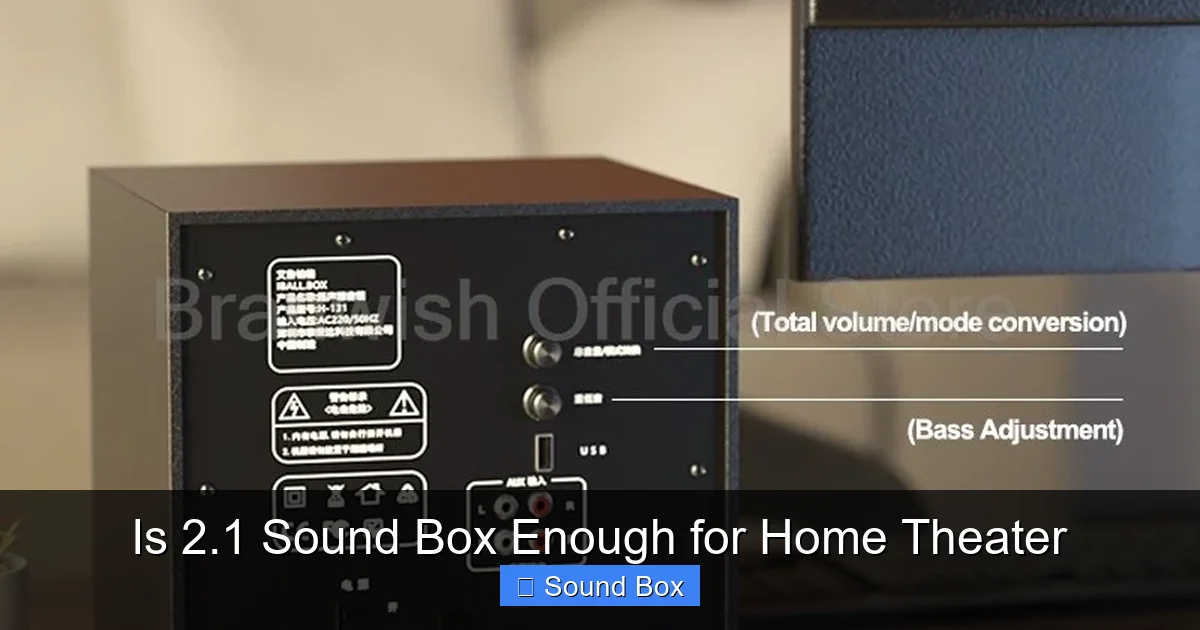
First off, what exactly is a 2.1 sound system? The numbers tell the story. The “2” refers to the two main channels or speakers, typically positioned in front of you. These are your left and right stereo speakers. The “.1” signifies the presence of a subwoofer, which is a speaker dedicated solely to reproducing low-frequency sounds – the deep bass you feel more than hear. So, in a 2.1 system, you have two satellite speakers and one subwoofer.
The Role of Each Component
The two satellite speakers are responsible for delivering the mid-range and high-frequency sounds. This includes things like dialogue, music, and most of the sound effects you’d hear in a movie or game. They provide a sense of width and detail to the audio coming from the front. The subwoofer, on the other hand, handles the rumble. Think explosions, car engines, the deep thrum of a spaceship, or the powerful bassline in music. Without a subwoofer, these sounds can feel flat and lack impact. A good subwoofer adds a physical dimension to the audio, making it much more engaging.
Why 2.1 is a Popular Choice
So, why is 2.1 such a common configuration? There are several good reasons. For starters, it’s significantly better than the built-in speakers on most TVs. TV speakers are usually small and don’t have the space to produce deep bass or a wide soundstage. A 2.1 system immediately offers a noticeable improvement in clarity and power. It’s also relatively simple to set up. You don’t have a complicated web of wires stretching across your room, and it doesn’t require a huge amount of space. For many people, it strikes a great balance between improved sound quality and ease of use. If you’re looking for a simple upgrade from your TV’s internal speakers, a 2.1 sound box is a solid contender.
## What a 2.1 System Can Do for Your Home Theater
Let’s get down to brass tacks. Can a 2.1 sound box truly elevate your home theater experience? The answer is a nuanced yes, with some important caveats. It definitely offers an improvement, but it’s not the full immersion that higher channel counts provide.
Improved Bass and Clarity
The most immediate benefit of a 2.1 system is the addition of a subwoofer. This is where you’ll notice the biggest difference compared to basic TV speakers. Movies will have more punch, music will feel richer, and video games will become more visceral. Explosions will boom, and dramatic moments will have a palpable weight. The two satellite speakers also generally offer better clarity and a wider stereo image than TV speakers, making dialogue easier to understand and sound effects more distinct. This is particularly helpful for discerning the nuances in dialogue, which is often a weak point for TV speakers.
Simplicity and Space Efficiency
One of the major advantages of a 2.1 system is its simplicity. You typically have a soundbar or a couple of small speakers, and a subwoofer. Setup is usually straightforward, often involving just a few cables. This makes it an ideal solution for smaller rooms or for those who don’t want a complex audio setup dominating their living space. If you’re working with limited space or prefer a minimalist aesthetic, a 2.1 sound box can be a fantastic choice. It gets you better sound without the clutter of multiple speakers around the room.
Limitations for True Immersion
However, it’s crucial to understand what a 2.1 system *doesn’t* do. It lacks dedicated surround channels. This means you won’t get sound coming from behind you or from the sides in the way a 5.1 or 7.1 system does. In a true home theater, sound design is often crafted to move around you, creating an immersive soundscape. A chase scene might have cars whizzing past your ears, or an explosion might feel like it’s happening all around you. A 2.1 system can’t replicate this. It primarily provides front-stage audio and bass. While the stereo separation from the two front speakers offers a good sense of width, it doesn’t offer the enveloping experience that surround sound provides. For true immersion, you’re missing those crucial rear and side channels.
- A 2.1 system delivers more impact than built-in TV speakers by adding a dedicated subwoofer for deeper bass and two stereo speakers for clearer dialogue and effects.
- It’s an excellent entry-level option for those new to home theater audio, offering a noticeable upgrade without complex setup or significant investment.
- The “surround” aspect is missing; a 2.1 system primarily provides front stereo sound and bass, not the immersive, multi-directional audio that defines true home theater.
- Room size and acoustics play a big role; in smaller rooms, a 2.1 system might feel more impactful, while larger spaces will highlight its limitations.
- For movie buffs and gamers seeking deep immersion, a 5.1 system (or higher) with dedicated rear and center channels is usually a better choice.
- Upgradability is a factor; many receivers that support 2.1 can also handle more channels, allowing you to expand later.
- Consider your primary use case; for casual TV watching and music, 2.1 might suffice, but for cinematic experiences, aim higher.
📑 Table of Contents
When is 2.1 “Enough”?
So, when does a 2.1 sound box meet the “enough” criteria for your home theater? It largely depends on your expectations and your specific needs.
For the Casual Viewer
If you’re a casual viewer who mainly watches TV shows, news, and the occasional movie, and you’re upgrading from your TV’s built-in speakers, then a 2.1 system is absolutely enough. It will provide a significant upgrade in audio quality, making dialogue clearer and adding satisfying bass to action sequences. For everyday listening, it’s a great improvement that doesn’t require a huge investment or complex setup. It’s a step up that enhances the overall viewing experience without overwhelming your living room.
For Small to Medium-Sized Rooms
In smaller living rooms or bedrooms, a 2.1 system can feel surprisingly impactful. The sound has less space to dissipate, and the bass from the subwoofer can fill the room more effectively. If your seating area is relatively close to the front speakers, the stereo separation will also be more pronounced. For these environments, the limitations of 2.1 might be less apparent than in a large, open-plan living space. The sound might feel more contained and thus, more powerful within the confines of a smaller area.
As a Starting Point
Perhaps the most common scenario where 2.1 is “enough” is as a starting point. Many people begin their home theater journey with a 2.1 system and later upgrade to a 5.1 or 7.1 setup as their budget and enthusiasm grow. Most AV receivers that support 2.1 systems also support higher channel counts. This means you can connect your current 2.1 setup and then simply add more speakers down the line without needing to replace your entire system. This makes a 2.1 system a wise initial investment for future expansion.
When You Need More Than 2.1
Visual guide about Is 2.1 Sound Box Enough for Home Theater
Image source: down-id.img.susercontent.com
There are definitely scenarios where a 2.1 system will leave you wanting more. If you’re aiming for that true cinematic thrill, or if you’re an avid gamer or movie buff, you’ll likely find the limitations of 2.1 quickly apparent.
For the Immersive Movie Buff
If you’re chasing the feeling of being in the movie, the 2.1 system falls short. True cinematic immersion comes from sounds that surround you. Think of the distinct sounds of an object flying past your head, or the feeling of being enveloped by a grand orchestral score. These experiences require surround sound speakers placed strategically around your listening area. A 5.1 system, for instance, adds two rear surround speakers and a center channel speaker, which is crucial for clear dialogue. For anyone who prioritizes the full, multi-dimensional audio experience of a movie theater, a 2.1 system is simply not enough. You need those extra channels to truly pull you into the story.
For Gamers Seeking Depth
Video games are an increasingly sophisticated medium, and their sound design is often just as important as their visuals. Games utilize surround sound to create awareness of enemy positions, enhance immersion in virtual worlds, and add dramatic impact to gameplay. Explosions, footsteps, ambient sounds – they all contribute to the gaming experience. A 2.1 system provides some bass and stereo separation, but it can’t replicate the directional audio cues that a 5.1 or 7.1 system offers. If you’re a serious gamer, you’ll benefit immensely from surround sound to gain a competitive edge and a more immersive play experience.
For Larger Rooms and Open Plan Living
In larger living rooms or open-plan spaces, a 2.1 system can struggle to provide adequate sound coverage. The audio might feel less impactful, and the bass might not reach all corners of the room effectively. The stereo separation will also be less pronounced when you’re further away from the front speakers. For these environments, a more robust system with additional speakers is needed to fill the space with engaging sound. If your room is quite large, a 2.1 system might feel underpowered and unable to deliver the desired audio experience across the entire area.
## Alternatives and Upgrades to 2.1
If you’ve decided that 2.1 might not be the perfect fit for your home theater, or if you’re looking to understand your options, let’s explore some alternatives and how to upgrade.
The Next Step: 3.1 and 5.1 Systems
The most logical upgrade from a 2.1 system is often a 3.1 or 5.1 system.
A 3.1 system adds a dedicated **center channel speaker** (the “.1” now refers to the subwoofer, and the “3” refers to the left, right, and center). This is a game-changer for dialogue clarity, as the center channel is primarily responsible for spoken words. Many people find this addition alone makes a huge difference for movies and TV shows. You can learn more about the best center speaker for home theater systems.
A 5.1 system adds two rear surround speakers to the 3.1 setup. These speakers provide the crucial surround sound effects, allowing audio to move around you. This is the most common configuration for a true home theater experience and offers a significant leap in immersion over 2.1. It’s the industry standard for a reason – it delivers a compelling surround-sound effect without being overly complex or expensive.
Soundbars with Virtual Surround
Some modern soundbars offer “virtual surround sound” features. These systems use advanced processing to try and simulate the effect of surround speakers using just the soundbar itself (and sometimes a wireless subwoofer, making it a 2.1 or 3.1 virtual system). While they can sometimes create a wider soundstage, they rarely replicate the true immersion of a discrete 5.1 system. They can be a good compromise for those who want better sound but absolutely cannot accommodate extra speakers. However, don’t expect them to fully replace the experience of physical surround speakers.
Higher Channel Counts (7.1 and Beyond)
For the ultimate in home theater audio, you can go beyond 5.1. A 7.1 system adds two more surround speakers, placed on the sides or slightly behind you, providing even more precise directional audio. Beyond that, systems like Dolby Atmos and DTS:X introduce height channels, allowing sound to come from above you, creating an even more three-dimensional audio experience. These systems are for the true audiophiles and home theater enthusiasts who want the absolute best and are willing to invest in the equipment and room treatment required.
## Practical Tips for Maximizing Your Sound Box
Whether you stick with a 2.1 system or aim higher, there are always ways to get the most out of your audio setup.
Placement is Key
The positioning of your speakers and subwoofer is critical. For a 2.1 system, place the two main speakers at ear level, forming an equilateral triangle with your primary listening position. The subwoofer placement is a bit more flexible, but generally, placing it in a corner can boost bass, though sometimes this can make it sound “boomy.” Experimenting with different locations can help you find the spot where the bass sounds most balanced and natural. For more advanced systems, understanding the correct placement for center, surround, and height speakers is even more vital. For example, the center channel should ideally be placed directly below or above your TV, at ear level, to ensure dialogue comes from the screen.
Room Acoustics Matter
The room itself plays a huge role in how your sound system performs. Hard surfaces like bare walls, tile floors, and large windows can reflect sound, leading to echoes and a muddy audio experience. Soft furnishings like carpets, curtains, and upholstered furniture can absorb sound, making the audio sound warmer and more controlled. If your room has a lot of hard surfaces, consider adding some acoustic treatment to improve the sound quality. This is often overlooked but can make a significant difference.
Understanding Your Receiver/Amplifier
If you’re using a separate AV receiver to power your speakers, understanding its settings is important. Features like speaker size, crossover frequency (the point at which bass is handed off from the main speakers to the subwoofer), and room correction software can all be adjusted to optimize the sound for your specific speakers and room. For a 2.1 system, ensuring the crossover is set correctly for your satellite speakers is crucial. You want the subwoofer to handle the deep bass, but not so much that it overpowers other frequencies or causes distortion.
Cable Quality and Connections
While you don’t need to spend a fortune on exotic cables, using appropriate gauge speaker wire and ensuring secure connections is important. The length of speaker cable can also have a minor impact, especially over very long runs. For home cinema systems, choosing the right speaker cable can help avoid signal loss and ensure you get the best sound quality your equipment is capable of. If you’re using HDMI for connectivity, ensure your cables are rated for the correct version to support high-resolution audio formats.
## Conclusion: Is 2.1 Enough?
So, to circle back to our main question: is a 2.1 sound box enough for home theater? The most honest answer is: it depends.
For many people, especially those looking to upgrade from basic TV speakers, a 2.1 system is a fantastic and sufficient solution. It offers a significant improvement in bass response and audio clarity, making movies, music, and games more enjoyable. It’s simple, space-efficient, and often the perfect entry point into the world of home theater audio. If your primary goal is better sound without complexity, and you don’t need that full enveloping surround-sound effect, then yes, a 2.1 system can absolutely be enough.
However, if your dream is a truly immersive cinematic experience, with sound that surrounds you and pulls you into the action, then a 2.1 system will likely fall short. To achieve that, you’ll need to consider systems with more channels, such as 5.1 or 7.1, which include dedicated surround speakers. These systems provide the multi-directional audio that defines the movie theater experience.
Ultimately, the best way to decide is to consider your priorities, your room, and your budget. A 2.1 system is a great starting point, offering a noticeable and satisfying audio upgrade. But if you’re chasing that ultimate home theater immersion, you’ll know when it’s time to aim for more.
Frequently Asked Questions
Will a 2.1 sound system be loud enough?
A 2.1 sound system can be quite loud, especially if it has a powerful subwoofer. The perceived loudness depends on the power output (wattage) of the individual components and the size of your room. For most typical living room sizes, a well-powered 2.1 system should provide ample volume for movies, music, and gaming.
Can a 2.1 system handle dialogue clearly?
A 2.1 system provides stereo separation with its two main speakers, which helps in delivering clearer dialogue compared to TV speakers. However, for maximum dialogue clarity, especially in complex movie soundtracks, a dedicated center channel speaker (found in 3.1 and higher systems) is highly beneficial, as it’s specifically designed to handle spoken words. While 2.1 is decent, it’s not optimal for dialogue-centric content.
Is a 2.1 system good for music?
Yes, a 2.1 system can be very good for music, offering a richer and more impactful listening experience than TV speakers. The stereo separation from the two main speakers provides a good sense of width, and the subwoofer adds depth and warmth to the bass frequencies, which can enhance many genres of music.
Can I add more speakers to a 2.1 system later?
Often, yes. If your 2.1 system is powered by an AV receiver, you can typically upgrade to a 5.1 or 7.1 system by adding more speakers and connecting them to your receiver. However, if you have an all-in-one soundbar system, upgradability might be limited, or you may need to purchase a complementary expansion pack if available from the manufacturer.
What is the main difference between 2.1 and 5.1 sound?
The main difference is the addition of surround sound channels. A 2.1 system has two front speakers and a subwoofer, providing stereo sound and bass. A 5.1 system adds two rear surround speakers and a center channel speaker, allowing sound to be placed around you, creating a more immersive and three-dimensional audio experience for movies and games.
How does room size affect the performance of a 2.1 system?
Room size significantly impacts a 2.1 system’s performance. In smaller rooms, the sound from the two front speakers and the subwoofer can fill the space effectively, providing a more impactful experience. In larger rooms, a 2.1 system may struggle to provide adequate coverage, with the sound feeling less powerful and the stereo separation less pronounced across the entire listening area.


