
Adding an AI sound box to your smart home system unlocks a new level of audio immersion and intelligent control. This guide will walk you through understanding compatibility, choosing the right device, and the step-by-step integration process for a smarter, more responsive home.
The world of smart homes is constantly evolving, and one of the most exciting advancements is the integration of artificial intelligence into our audio devices. An AI sound box isn’t just a speaker; it’s a smart hub that can understand your commands, learn your preferences, and become an integral part of your connected living space. Imagine a home that responds to your voice not just for lights and thermostats, but also for music, podcasts, and ambient sounds, all orchestrated by an intelligent audio system. Adding an AI sound box to your smart home system can dramatically enhance your daily routines, from waking up to your favorite playlist to controlling your home environment with simple voice commands.
But how do you actually go about integrating this cutting-edge technology into your existing setup? It might sound daunting, but with a little guidance, it’s a surprisingly straightforward process. This article will demystify the world of AI sound boxes, explaining what they are, why you’d want one, and most importantly, how to add an AI sound box to your smart home system. We’ll cover everything from choosing the right device to the nitty-gritty of setup and making the most of its smart capabilities.
- Understanding Compatibility: Before buying, check if the AI sound box supports your existing smart home ecosystem (e.g., Google Home, Alexa, Apple HomeKit).
- Choosing the Right AI Sound Box: Consider features like sound quality, AI capabilities, connectivity options (Wi-Fi, Bluetooth), and voice assistant integration.
- Connectivity Options: Determine if you’ll connect via Wi-Fi for broader smart home integration or Bluetooth for simpler, direct streaming.
- Setup and Integration: Follow the manufacturer’s instructions carefully, which usually involve app setup, network connection, and linking to your smart home account.
- Voice Command and Automation: Once integrated, leverage voice commands for playback and create routines that link audio with other smart home devices.
- Troubleshooting Common Issues: Be prepared for potential connection problems, sound quality adjustments, and firmware updates to ensure optimal performance.
📑 Table of Contents
What Exactly is an AI Sound Box?
Before we dive into the “how,” let’s clarify what we mean by an “AI sound box.” At its core, it’s a smart speaker powered by artificial intelligence. This means it goes beyond simply playing audio. It’s equipped with microphones to listen for your voice commands, processors to understand natural language, and connectivity to interact with other devices and services. Think of devices like Amazon Echo, Google Nest, or Apple HomePod. These are prime examples of AI sound boxes that serve as the brains of many smart home setups, handling a vast array of tasks through voice interaction.
The AI Advantage: Beyond Basic Playback
The “AI” in AI sound box is the game-changer. It allows for:
- Natural Language Understanding: You can speak to it conversationally, rather than using rigid commands. “Play some relaxing jazz” is much easier than “Play artist X, album Y, song Z.”
- Personalization: Over time, many AI sound boxes learn your listening habits, favorite genres, and even your daily schedule, offering more tailored recommendations and responses.
- Contextual Awareness: Some advanced AI systems can understand the context of your requests. If you ask “What’s the weather like?” and then “What about tomorrow?”, the AI knows you’re still asking about the weather.
- Integration with Smart Home Ecosystems: This is crucial for our topic. AI sound boxes act as central control points for your other smart devices.
Types of AI Sound Boxes
While the term “AI sound box” is broad, you’ll typically find them categorized by their primary voice assistant:
- Amazon Alexa-powered devices (Echo): Known for their wide range of skills and extensive smart home compatibility.
- Google Assistant-powered devices (Nest): Excellent at providing information and integrating with Google services.
- Apple HomeKit-compatible devices (HomePod): Focuses on privacy and seamless integration within the Apple ecosystem.
- Other proprietary systems: Some brands offer their own AI sound boxes with unique features.
Step 1: Assess Your Smart Home Ecosystem and Needs
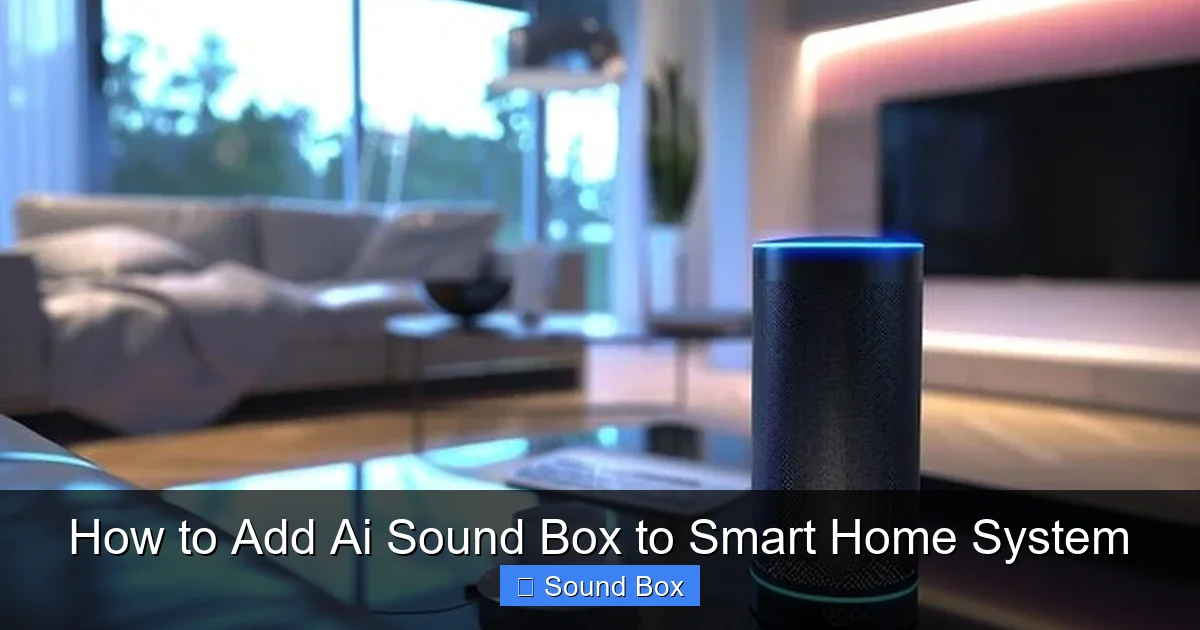
Visual guide about How to Add Ai Sound Box to Smart Home System
Image source: img.freepik.com
The very first step to adding an AI sound box to your smart home system is to understand what you already have and what you want it to do. This crucial foundational step prevents compatibility headaches and ensures you choose a device that truly benefits you.
Compatibility is Key
Most smart home devices operate within specific ecosystems. The major players are:
- Google Home/Google Assistant: If you primarily use Android phones, Google services (Gmail, Calendar, etc.), or have other Google Nest devices, a Google Assistant-powered sound box is a natural fit.
- Amazon Alexa: If you’re already invested in Amazon products or have many Alexa-compatible smart devices, an Echo device will likely integrate smoothly.
- Apple HomeKit: If you’re an Apple user with iPhones, iPads, and Macs, an Apple HomePod will offer the most seamless integration, prioritizing privacy.
You can often link devices from different ecosystems, but it’s generally less straightforward and might limit functionality. For example, you can connect a Bluetooth speaker to Google Home, but it won’t have the same level of integration as a native Google Assistant device. We’ll discuss this more later when we talk about connectivity.
Define Your Goals
What do you want your AI sound box to achieve in your smart home?
- Music and Entertainment: Do you want to stream music, podcasts, or audiobooks with voice commands?
- Smart Home Control: Do you want to control lights, thermostats, smart plugs, or security cameras?
- Information and Assistance: Do you need quick answers to questions, weather updates, or setting timers and alarms?
- Communication: Do you want to make calls or send messages using voice?
- Ambient Soundscapes: Do you want to create specific sound environments for relaxation or focus?
Answering these questions will help you narrow down the features you need in an AI sound box.
Step 2: Choosing the Right AI Sound Box
Visual guide about How to Add Ai Sound Box to Smart Home System
Image source: img.freepik.com
Once you know your ecosystem and your needs, it’s time to pick the actual AI sound box. The market offers a wide range, from compact smart speakers to more premium audio devices.
Key Features to Consider
When looking at different AI sound boxes, pay attention to:
- Sound Quality: This is paramount for an audio device. Read reviews, and if possible, listen to a demo. Some AI sound boxes are designed for audiophiles, while others prioritize smart features over bass.
- Microphone Array: A good microphone system ensures the device can hear you clearly, even in noisy environments or from across the room.
- Connectivity Options: Look for Wi-Fi (essential for smart home integration) and Bluetooth (for direct streaming from phones/tablets). Some also support aux-in for wired connections.
- AI Assistant Capabilities: Does it support your preferred voice assistant (Alexa, Google Assistant, Siri)? What “skills” or “actions” does it have access to?
- Design and Size: Consider where you’ll place it and how it will fit with your home decor.
- Privacy Features: Many devices have physical microphone mute buttons and options to review or delete voice recordings.
- Multi-room Audio: If you plan to have more than one AI sound box, check if they can sync for music playback throughout your home.
Examples of AI Sound Boxes
* For a Balanced Experience: Google Nest Audio or Amazon Echo (various generations). These offer a good mix of sound quality and smart home integration at a reasonable price.
* For Premium Audio: Apple HomePod (latest generation) or Sonos One (with Alexa or Google Assistant built-in). These deliver superior sound and robust smart features.
* For Budget-Conscious Integration: Google Nest Mini or Amazon Echo Dot. These are smaller, less expensive, and great for adding voice control to specific rooms.
Step 3: The Setup and Integration Process
Visual guide about How to Add Ai Sound Box to Smart Home System
Image source: img.freepik.com
This is where we get hands-on! The setup process for most AI sound boxes is designed to be user-friendly, usually involving a mobile app.
Unboxing and Initial Power-Up
1. **Unbox your AI sound box:** Carefully remove it from the packaging.
2. **Plug it in:** Connect the power adapter and plug it into a wall outlet. The device will likely light up or play a startup sound.
3. **Download the Companion App:** On your smartphone or tablet, download the app associated with your AI sound box (e.g., Google Home app for Google Nest devices, Amazon Alexa app for Echo devices).
Connecting to Your Wi-Fi Network
The companion app will guide you through this.
1. **Open the App:** Launch the app and follow the prompts to add a new device.
2. **Select Your Device:** Choose the specific AI sound box model you’ve purchased.
3. **Connect to Temporary Network (if applicable): Some devices create a temporary Wi-Fi network for initial setup. Your phone will connect to this.
4. **Choose Your Home Wi-Fi:** Select your home Wi-Fi network from the list and enter your password.
5. **Confirmation:** The app will confirm when the device is successfully connected to your Wi-Fi.
Linking to Your Smart Home Account
This is the crucial step for smart home integration.
1. **Sign In/Create Account:** Log in to your existing Google, Amazon, or Apple account within the app. If you don’t have one, you’ll be prompted to create one.
2. **Grant Permissions:** The app will ask for permission to access your location, contacts, and other data necessary for the AI assistant to function.
3. **Discover Devices:** Most apps will then prompt you to discover existing compatible smart home devices already connected to your account (e.g., Philips Hue lights, Nest thermostat). If your devices aren’t found, you might need to go into the individual device’s app and link it to your Google or Alexa account (often found under “Skills” or “Works with” sections).
4. **Assign Rooms:** To make control easier, assign your AI sound box and other smart devices to specific rooms in your home (e.g., “Living Room,” “Bedroom”).
Bluetooth Connectivity (Optional but Useful)
While Wi-Fi is essential for full smart home integration, Bluetooth offers a simpler way to stream audio directly from your phone or tablet.
1. **Enable Bluetooth:** On your phone or tablet, turn on Bluetooth.
2. **Pairing Mode:** Put your AI sound box into Bluetooth pairing mode. This is usually done by a voice command (e.g., “Alexa, pair Bluetooth” or “Hey Google, pair Bluetooth”) or by pressing a button on the device.
3. **Select Device:** Your AI sound box should appear in your phone’s Bluetooth device list. Select it to pair.
4. **Enjoy Direct Streaming:** Once paired, any audio played on your phone can be routed through the AI sound box. This is handy if you want to play music from an app not directly supported by the AI assistant. For improving Bluetooth speaker sound quality generally, you might find these tips useful.
Step 4: Using Your AI Sound Box for Smart Home Control and Audio
With your AI sound box set up, you’re ready to experience the magic of an integrated smart home.
Voice Commands for Smart Home Devices
Now, try controlling your connected devices:
* “Hey Google, turn on the living room lights.”
* “Alexa, set the thermostat to 72 degrees.”
* “Siri, lock the front door.”
If you have multiple speakers, you can often group them. For example, you might be able to say, “Alexa, turn off all the lights downstairs.”
Music and Entertainment Control
* “Hey Google, play my ‘Chill Vibes’ playlist on Spotify.”
* “Alexa, what’s the news?”
* “Siri, play the latest episode of ‘The Daily’.”
You can also use commands like “Pause,” “Skip,” “Volume up/down,” and “Stop.” If you’re interested in how to connect a smart TV to a Bluetooth speaker for a better experience, that’s another area where AI sound boxes can play a role, often acting as a bridge.
Creating Routines and Automations
This is where the real power of a smart home comes to life. Routines allow you to trigger multiple actions with a single voice command.
* **”Good Morning” Routine:** You could set up a routine where saying “Hey Google, good morning” turns on your bedroom lights, tells you the weather and your calendar, and starts playing your favorite morning radio station.
* **”Movie Night” Routine:** A command like “Alexa, it’s movie time” could dim the lights, turn on the TV, and set the thermostat to a comfortable temperature.
These automations can significantly streamline your daily life and make your home more responsive and convenient. You might also be interested in how to create awesome backyard surround sound, where AI speakers could be a part of the setup.
Step 5: Troubleshooting and Maintenance
Even the most advanced technology can sometimes hit a snag. Here are common issues and how to address them.
Connectivity Problems
* **No Response:** Ensure your AI sound box is powered on and connected to your Wi-Fi. Restart your router and the sound box.
* **Unresponsive Smart Devices:** Check if the individual smart devices are online and connected to your home network. Ensure their respective apps are updated and properly linked to your AI assistant account.
Sound Quality Issues
* **Poor Audio:** Make sure the speaker isn’t obstructed. For Bluetooth connections, ensure you’re within range and that there isn’t too much interference. If the sound quality is consistently poor, you might be dealing with a hardware issue, or perhaps the speaker placement isn’t optimal. For instance, knowing how to place surround speakers can make a big difference in any audio setup. You might also need to check if your speaker cables are up to par if you’re using a more complex home cinema setup.
* **Echo or Feedback:** This is less common with standalone AI sound boxes but can occur if multiple devices are too close or in very small, enclosed spaces.
Firmware Updates
AI sound boxes receive regular software updates to improve performance, add new features, and enhance security. These usually happen automatically, but it’s good practice to check the companion app periodically to ensure your device is running the latest firmware. If you encounter a persistent issue, a firmware update might be the solution.
Privacy Concerns
Most AI sound boxes have features to manage your privacy. You can usually mute the microphone with a physical button, and you can access your voice history through the app to review and delete recordings. Familiarize yourself with these settings to ensure you’re comfortable with how your data is being used.
Conclusion
Adding an AI sound box to your smart home system is a fantastic way to enhance your audio experience and unlock a new level of intelligent automation. By understanding your existing ecosystem, choosing the right device for your needs, and following the straightforward setup process, you can seamlessly integrate this powerful technology into your daily life. From effortless music playback to controlling your entire smart home with your voice, an AI sound box is more than just a speaker – it’s a gateway to a more responsive, convenient, and enjoyable living space. So, dive in, experiment with commands, and discover all the ways your new AI sound box can make your smart home even smarter.
Frequently Asked Questions
What is the difference between a smart speaker and an AI sound box?
There is no fundamental difference; the terms “smart speaker” and “AI sound box” are often used interchangeably. Both refer to audio devices that use artificial intelligence to understand voice commands, access online services, and control other smart home devices.
Do I need a separate AI sound box for each room?
Not necessarily. You can have one central AI sound box that controls devices throughout your home. However, having an AI sound box in multiple rooms allows for voice control and audio playback specific to that location, enhancing convenience.
Can I use an AI sound box with any smart home device?
Compatibility varies. AI sound boxes are designed to work with specific smart home ecosystems (like Google Home, Amazon Alexa, or Apple HomeKit). Ensure the smart devices you own are compatible with your chosen AI sound box’s ecosystem for seamless integration.
How does an AI sound box learn my preferences?
AI sound boxes learn through your interactions. They track the music you play, the commands you give, and the services you use. This data, processed by AI algorithms, helps them personalize responses and recommendations over time.
Is it difficult to set up an AI sound box?
Generally, no. Most AI sound boxes come with a user-friendly companion app that guides you through connecting to Wi-Fi, linking to your smart home account, and discovering other devices. It typically takes less than 15-20 minutes for basic setup.
Can an AI sound box replace my existing stereo system?
For basic music listening and smart home control, many AI sound boxes can effectively replace a stereo system. However, for critical audiophiles seeking the highest fidelity or complex multi-channel setups, a dedicated stereo or home theater system might still be preferred, though AI speakers can complement these too.


