Yes, you absolutely can use Bluetooth speakers with a turntable, but it often requires a little extra gear. We’ll show you exactly how to connect them and get your vinyl sounding awesome, even wirelessly!
Hey there, fellow music lovers! You know that feeling when you spin a favorite record, and the warm, rich sound fills the room? It’s magical, right? But what if you want that amazing vinyl sound to reach your super convenient Bluetooth speaker across the room? Maybe you’ve got a sleek new speaker and a classic turntable, and you’re wondering if they can play nice together. It can feel a bit confusing with all the different gadgets and wires out there. Don’t worry, though! I’m here to break it all down for you. We’ll make sure you can enjoy your records anywhere, just the way you like. Let’s dive in and unlock that wireless vinyl magic!
Let’s Talk About Sound: Turntables and Modern Speakers
Think about your turntable. It’s a beautiful piece of tech, bringing those physical records to life. It produces an analog signal, which is super pure and full of character. Now, think about your Bluetooth speaker. It’s a marvel of modern convenience, connecting wirelessly to your phone or tablet with just a tap. The challenge? These two worlds don’t always speak the same language right out of the box. Your turntable needs a way to “talk” to your wireless speaker, and that’s where we come in.
This guide is all about bridging that gap. We’ll explore the different ways you can connect your beloved vinyl to your wireless sound system. Whether you have a vintage turntable or a brand-new one, and whether your Bluetooth speaker is a tiny portable one or a booming home system, we’ve got you covered. We’ll keep it super simple, just like we’re hanging out and figuring this tech puzzle together.
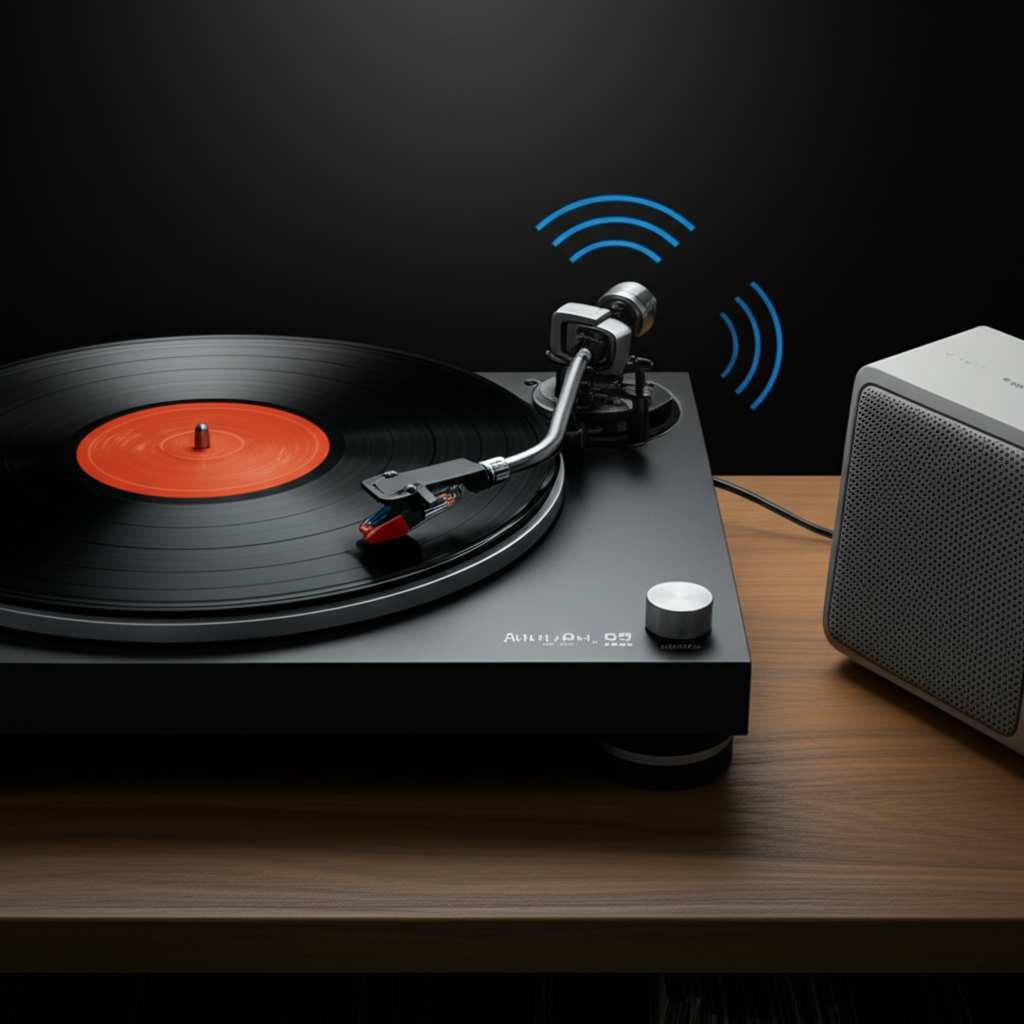
The Big Question: Can You Really Use Bluetooth Speakers with a Turntable?
The short answer is: yes, but usually with an adapter or a specific type of turntable. Most traditional turntables don’t have built-in Bluetooth transmitters. They send their sound signal through cables to an amplifier or receiver. Bluetooth speakers, on the other hand, are designed to receive signals wirelessly. So, you need something to convert that turntable’s cable signal into a Bluetooth signal. It’s like giving your turntable a translator so it can chat with your wireless speaker!
But here’s the exciting part: there are some awesome turntables that do have Bluetooth built right in! These are made for easy connection to modern speakers. So, depending on your setup, the solution might be super simple or require a small, affordable gadget. We’ll explore both possibilities.
Understanding Your Turntable’s Connections
Before we connect anything, let’s peek at the back of your turntable. You’ll usually see a couple of RCA cables sticking out. These are red and white, or sometimes black. These cables carry the audio signal from your record. Some turntables also have a ground wire, a small thin wire that helps reduce hum.
You might also see a switch labeled “Phono” or “Line.” This is super important!
Phono: This setting is for turntables that connect to an amplifier with a special “Phono” input. The signal is very weak here.
Line: This setting is for turntables that have a built-in pre-amp. The signal is stronger and can go directly to most audio devices.
If your turntable only has a “Phono” output, you’ll definitely need a phono pre-amp. Many modern turntables include this built-in, making things much easier. If you see both “Phono” and “Line,” set it to “Line” for most connections, especially when using Bluetooth adapters.
Method 1: The “Bluetooth Transmitter” Magic Wand
This is the most common way to connect a standard turntable to Bluetooth speakers. Think of a Bluetooth transmitter as a tiny gadget that listens to your turntable’s audio cables and broadcasts that sound wirelessly. It’s like giving your old-school turntable a modern Bluetooth upgrade!
What You’ll Need:
Your turntable (with a built-in pre-amp or connected to an external phono pre-amp).
A Bluetooth Transmitter.
Your Bluetooth Speaker.
The necessary cables (usually RCA or 3.5mm audio cables, often included with the transmitter).
How to Set It Up (Step-by-Step):
1. Power Up Your Transmitter: Plug your Bluetooth transmitter into a power source. This is usually a USB cable that you can plug into a wall adapter or even a USB port on a TV or computer.
2. Connect Turntable to Transmitter: This is the crucial step.
If your turntable has a Line Out (or built-in pre-amp), connect the RCA cables from your turntable’s audio output directly to the “Audio In” ports on your Bluetooth transmitter. Make sure you match the red to red and white to white.
If your turntable only has a Phono Out, you must connect it to a separate Phono Pre-amp first. Then, connect the RCA cables from the phono pre-amp’s “Line Out” to the “Audio In” ports on your Bluetooth transmitter.
3. Pair Your Transmitter with Your Speaker: Put your Bluetooth transmitter into pairing mode. This usually involves pressing and holding a button until a light starts flashing. Then, put your Bluetooth speaker into pairing mode as well. They should find each other automatically.
4. Check Your Speaker: Once paired, the flashing light on the transmitter should become solid, indicating a successful connection.
5. Play Your Record: Put on a record and enjoy the sound coming from your Bluetooth speaker! You might need to adjust the volume on both the transmitter (if it has volume controls) and your speaker.
Here’s a little tip: Some Bluetooth transmitters can connect to two speakers at once! This is great if you want stereo sound from two separate speakers. Just check the transmitter’s specs.
Method 2: The “Bluetooth Receiver” Approach (If You Have an Amplifier)
What if you already have an amplifier or receiver that’s connected to your turntable? You can still go wireless! In this case, you’ll use a Bluetooth receiver. It’s the opposite of a transmitter – it receives the Bluetooth signal and sends it to your amplifier.
What You’ll Need:
Your turntable.
An amplifier or receiver with RCA inputs.
A Bluetooth Receiver.
Your Bluetooth Speaker (this is a bit different – you’re not sending the signal to the speaker, but rather using the receiver to send the turntable’s signal to your existing stereo system, which then might be paired with Bluetooth speakers). Wait, this is confusing. Let’s rephrase.
Okay, let’s re-think this. If you have an amplifier and want to send that sound to your Bluetooth speaker, the receiver is connected to the amplifier, and the amplifier is connected to the turntable. Then you can connect your Bluetooth speaker to the amplifier if it has Bluetooth out, or use a Bluetooth transmitter connected to the amplifier’s output.
This is getting complicated, and our goal is to get the turntable sound to the Bluetooth speaker. So, let’s simplify the receiver part. The receiver is mostly for when you want to send sound from your phone/tablet to your existing wired stereo system. For our goal, the transmitter is the key player for getting turntable sound to a Bluetooth speaker.
Let’s stick to the transmitter method, as it’s the direct path for this article’s core question.
Method 3: Turntables with Built-In Bluetooth
This is the easiest route if you’re buying a new turntable or looking to upgrade. Many modern turntables come with Bluetooth transmitters built right in. It’s like they’ve already done the adapter work for you!
How to Set It Up:
1. Power On Your Turntable: Plug it in and turn it on.
2. Put Turntable in Pairing Mode: There will be a dedicated Bluetooth button on the turntable itself. Press and hold it until the Bluetooth indicator light starts flashing.
3. Put Your Bluetooth Speaker in Pairing Mode: Just like you would when connecting your phone.
4. Wait for the Connection: The indicator light on your turntable should turn solid once it’s successfully paired with your speaker.
5. Play Your Record: Spin that vinyl and enjoy!
These turntables are fantastic because they simplify the whole process. You don’t need any extra boxes or cables to get wireless sound. It’s plug-and-play (or rather, plug-and-spin-and-play!).
What to Look For in a Bluetooth Transmitter/Turntable
When you’re choosing a transmitter or a turntable with Bluetooth, here are a few things to keep in mind:
Bluetooth Version: Newer versions like Bluetooth 5.0 or 5.1 offer better range, stability, and audio quality than older versions.
Codec Support: Look for support for codecs like aptX or aptX HD. These are like super-highways for audio, meaning your music will sound clearer and more detailed over Bluetooth.
Input/Output Options: Make sure the transmitter has the right audio inputs for your turntable (RCA is common) and that your speaker has the right inputs if you’re using a receiver setup.
Battery Life (for Transmitters): If you plan to move your transmitter around, check how long the battery lasts. Some are rechargeable, while others need to stay plugged in.
Ease of Pairing: Some devices are easier to pair than others. Read reviews to see if people find it straightforward.
Comparing Features: Turntable Connectivity Options
Let’s look at how different setups stack up. This table compares the common ways you might connect your turntable to speakers, focusing on getting that sound to your wireless speakers.
| Method | Requires Extra Gear? | Ease of Setup | Audio Quality Potential | Typical Cost Range |
|---|---|---|---|---|
| Turntable w/ Built-in Bluetooth | No (for Bluetooth connection) | Very Easy | Good to Excellent (depends on turntable/speaker) | $$ – $$$$ |
| Standard Turntable + Bluetooth Transmitter | Yes (Transmitter, Pre-amp if needed) | Moderate | Good to Very Good (depends on transmitter/speaker) | $ – $$ |
| Standard Turntable + Wired Speakers | Yes (Amplifier/Receiver, Speakers) | Moderate | Excellent | $$ – $$$$ |
As you can see, turntables with built-in Bluetooth offer the simplest path to wireless. However, a good Bluetooth transmitter is a fantastic and often more affordable way to give your existing turntable Bluetooth capabilities. The “Wired Speakers” option is the classic way to get the best sound, but it doesn’t get you wireless to your Bluetooth speaker.
Why Does Audio Quality Matter So Much?
When you’re listening to vinyl, you’re often seeking a certain warmth and richness. Bluetooth technology has gotten incredibly good, but there can still be a slight difference compared to a direct wired connection. Think of it like this:
Wired Connection: This is like a direct, super-clear phone call. The sound travels straight from your turntable to your speakers without any interruptions. It’s the purest way to hear your records.
Bluetooth Connection: This is more like a high-quality video call. It’s amazing and convenient, but there might be tiny imperfections or a slight delay. Using higher-quality Bluetooth codecs (like aptX) helps make this “video call” as good as possible, preserving more of that vinyl magic.
The good news is, for most listeners, the convenience of Bluetooth speakers with a turntable is well worth any minor perceived difference in audio fidelity. Especially with modern Bluetooth tech, you’ll likely be thrilled with the sound!
Troubleshooting Common Issues
Sometimes, tech just doesn’t cooperate right away. If you’re having trouble, don’t panic! Here are a few common hiccups and how to fix them:
No Sound:
Check all cable connections. Are they plugged in firmly?
Is the transmitter powered on?
Is your Bluetooth speaker turned on and charged?
Is the volume turned up on both the transmitter (if applicable) and the speaker?
Did you select the correct input on your amplifier (if using one)?
Humming or Buzzing:
This is often a grounding issue. Make sure the ground wire from your turntable is securely connected to the ground post on your phono pre-amp or receiver.
Try moving the Bluetooth transmitter away from other electronic devices.
Use a different power outlet.
Connection Drops:
Make sure your transmitter and speaker are within the recommended Bluetooth range (usually about 30 feet or 10 meters).
Obstacles like thick walls can interfere. Try moving the speaker closer.
Ensure both devices are using a modern Bluetooth version.
Audio Delay (Lip Sync Issues):
This is more common with video, but it can happen with music too. Some Bluetooth transmitters have a low-latency mode (often advertised as aptX Low Latency). If your transmitter and speaker both support this, it can significantly reduce delay.
If it’s a significant delay, you might need to consider a wired connection for critical listening.
If you’re still stuck, check the manuals for your turntable, transmitter, and speaker. They often have detailed troubleshooting sections. For more advanced help, sites like CNET offer tons of tech guides and forums.
Fun Facts About Bluetooth and Vinyl!
Did you know that the original Bluetooth technology was named after a Viking king, Harald Bluetooth? He was known for uniting warring tribes, much like Bluetooth aims to unite different devices! It’s pretty cool how history and tech can connect.
And when it comes to vinyl, the resurgence is amazing! More and more people are discovering the joy of physical music formats. It’s not just about nostalgia; there’s a tangible connection to the music that digital can’t always replicate. Combining that with modern wireless tech is a win-win!
Choosing the Right Setup for You
The best setup really depends on what you have and what you want.
For the Absolute Beginner with a New Turntable: A turntable with built-in Bluetooth is your easiest bet. Just pair it with your speaker and go!
For Someone with an Existing Turntable: A Bluetooth transmitter is usually the most cost-effective and straightforward solution. Just make sure your turntable has a line-out or you have a phono pre-amp.
For the Audiophile: While Bluetooth is convenient, a direct wired connection to a good stereo system will always offer the most pristine sound. But hey, convenience is pretty sweet too!
Don’t be afraid to experiment! The world of tech is all about finding what works best for your listening experience.
Frequently Asked Questions (FAQ)
- Do all turntables have Bluetooth?
- No, not all turntables have Bluetooth. Many traditional and vintage turntables do not. However, many newer models are now being released with built-in Bluetooth transmitters for easy wireless connectivity.
- What is a phono pre-amp and do I need one?
- A phono pre-amp boosts the very weak signal from your turntable’s cartridge to a level that other audio components can use. If your turntable only has a “Phono Out” or no “Line Out” switch, you’ll need a phono pre-amp. Many modern turntables have this built-in, so check your turntable’s settings!
- Can I use my regular Bluetooth headphones with a turntable?
- Yes, you can! Just like with Bluetooth speakers, you’ll typically need a Bluetooth transmitter connected to your turntable (or its pre-amp/receiver) to send the signal to your headphones wirelessly.
- Will the sound quality be bad if I use Bluetooth?
- Modern Bluetooth technology, especially with codecs like aptX and aptX HD, offers very good sound quality that is more than satisfactory for most listeners. While a direct wired connection is theoretically purest, the difference is often minimal and the convenience is a huge bonus!
- How far can my turntable’s Bluetooth signal reach?
- Standard Bluetooth range is typically around 30 feet (10 meters) in an open area. Walls and other electronic devices can reduce this range and potentially cause interference.
- Is it better to use a transmitter or a receiver?
- For connecting a turntable to Bluetooth speakers, you’ll primarily use a Bluetooth transmitter. A receiver is used when you want to send audio from a Bluetooth device (like your phone) to* a non-Bluetooth stereo system.
Conclusion: Your Vinyl, Your Way!
So there you have it! Connecting your turntable to Bluetooth speakers is totally doable and can bring a whole new level of freedom to your vinyl listening. Whether you opt for a turntable with integrated Bluetooth or add a simple transmitter to your existing setup, you’re on your way to enjoying that classic record sound with modern convenience.
Don’t let tech jargon scare you. It’s all about finding the right bridge between your favorite music and your favorite speakers. Give it a try, experiment with the methods we talked about, and find what makes your listening experience perfect. Now go enjoy amazing sound and make every moment louder and better!