A 1000 watt sound box is incredibly powerful and can be excessively loud for typical home use, potentially causing hearing damage and neighborly disturbances. While offering impressive volume, it’s crucial to consider room size, insulation, and local noise ordinances. For most homes, significantly lower wattage speakers are more than sufficient for an enjoyable audio experience.
Have you ever found yourself gazing at a powerful-looking speaker system, perhaps a hefty 1000 watt sound box, and wondered if it’s the right choice for your humble abode? The allure of booming bass and room-filling sound is undeniable. But before you click “add to cart,” let’s have a friendly chat about whether a 1000 watt sound box is actually too loud for home use. It’s a question that pops up often, and the answer isn’t a simple yes or no. It depends on a few things, and understanding them will help you make the best decision for your listening pleasure and your peace of mind.
We love our music, our movies, and our games, and having a sound system that truly immerses us is a fantastic feeling. However, there’s a fine line between enjoying powerful audio and creating an environment that’s either damaging to your hearing or a nuisance to everyone around you. A 1000 watt sound box represents a significant amount of power, and that power translates directly to volume. So, let’s dive deep and explore what this means for your home.
- A 1000 watt sound box is generally too loud for most standard home environments. Its sheer power is designed for large spaces or outdoor events.
- Volume perception is subjective and depends on room acoustics and listener sensitivity. What’s comfortable for one person might be overwhelming for another.
- Prolonged exposure to high decibel levels can cause permanent hearing damage. Even seemingly “not too loud” sounds can be harmful over time.
- Consider your neighbors and local noise ordinances. Excessive volume can lead to complaints and legal issues.
- Lower wattage speakers, often in the 50-200 watt range, are usually sufficient for enjoyable home listening. They provide ample volume without being overwhelming.
- Room size and insulation play a significant role in how loud sound will be perceived. A larger, well-insulated room can handle more power than a smaller, less insulated one.
- Responsible listening habits are key, regardless of speaker wattage. Always be mindful of the volume and its potential impact on yourself and others.
📑 Table of Contents
Understanding Speaker Wattage
Before we tackle the “too loud” question directly, it’s helpful to understand what wattage actually means in the context of speakers. Wattage, in essence, is a measure of power. For a sound box, it indicates how much electrical power the amplifier can deliver to the speaker drivers. A higher wattage generally means a speaker can produce a louder sound.
Watts vs. Decibels: What’s the Real Measure of Loudness?
It’s easy to equate watts directly with loudness, but that’s not the whole story. While higher wattage *allows* for more volume, the actual perceived loudness is measured in decibels (dB). A small increase in wattage doesn’t necessarily result in a drastic increase in decibels. For example, doubling the wattage of an amplifier doesn’t double the loudness; it only increases it by about 3 dB. This is because human hearing perceives loudness logarithmically. So, while a 1000 watt sound box has the *potential* to be significantly louder than a 100 watt one, the difference in dB might not be as dramatic as you’d initially think. However, 1000 watts still offers a substantial amount of headroom for extremely high volume levels.
What Wattage is Typically for Home Use?
For most typical home listening scenarios, speakers in the range of 50 to 200 watts are usually more than adequate. These speakers can fill a room with sound, provide satisfying bass, and offer a dynamic listening experience without pushing the boundaries of what’s comfortable or practical. If you’re looking for a good starting point for home audio, understanding how many watts is best for a Bluetooth speaker for home use is a great way to gauge appropriate power levels. Even high-quality speakers designed for an immersive home cinema experience often fall within this wattage range, perhaps a bit higher for dedicated subwoofers.
Is 1000 Watts Too Loud for Your Home? The Practicalities
Visual guide about Is 1000 Watt Sound Box Too Loud for Home Use
Image source: popsci.com
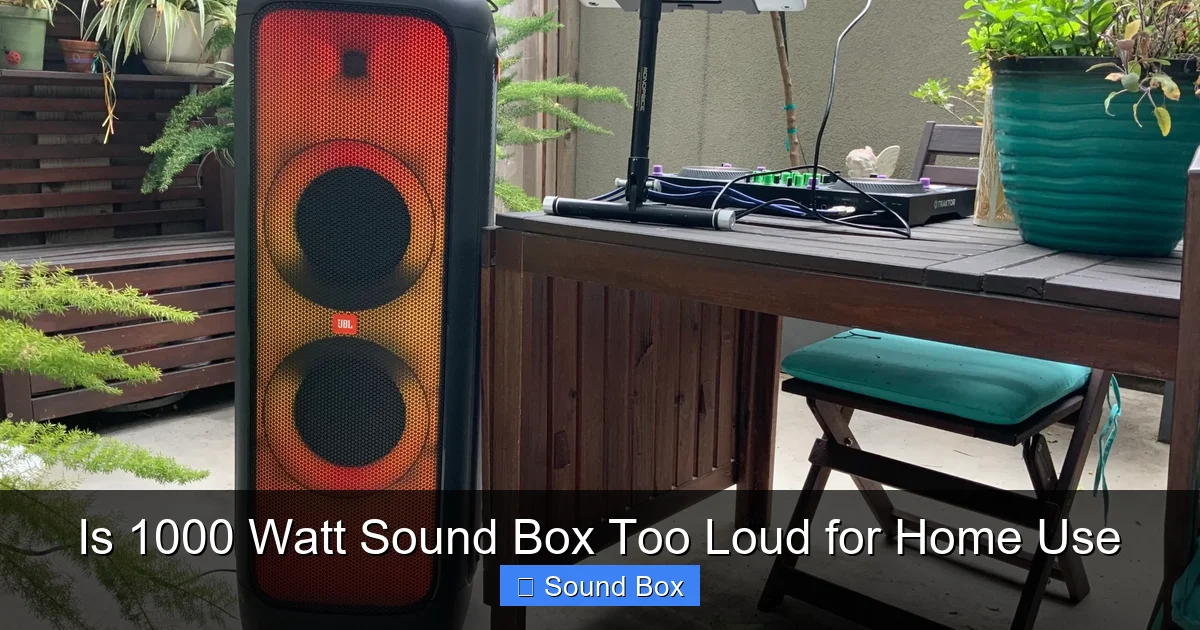
Now, let’s get to the heart of it. Is a 1000 watt sound box overkill for your living room, bedroom, or home office? In most cases, the answer is yes, it is likely too loud for regular, comfortable home use. Here’s why:
Room Size and Acoustics Matter
The size of your listening space is a critical factor. A 1000 watt sound box is designed to fill large venues, outdoor spaces, or auditoriums with sound. In a typical bedroom, living room, or even a larger open-plan home, this level of power would be overwhelming. The sound waves would reflect off surfaces rapidly, creating an unpleasantly loud and potentially distorted experience. The sound wouldn’t just be loud; it would be jarring. Even for a spacious home, consider how large Bluetooth speakers might impact the overall ambiance, as size doesn’t always equate to comfort for everyday listening.
The Danger of Hearing Damage
This is perhaps the most important consideration. Prolonged exposure to loud noises can cause irreversible hearing damage. The World Health Organization recommends that continuous noise exposure should not exceed 85 dB for extended periods. Many 1000 watt sound boxes can easily surpass this threshold, even at moderate volume knob settings, especially in smaller, enclosed spaces. At higher settings, they can reach levels well over 100 dB, which can cause damage in minutes. It’s vital to be mindful of your hearing health, and using such a powerful speaker at its intended volume at home is a recipe for potential harm.
Neighborly Relations and Noise Ordinances
Living in proximity to others means a responsibility to be considerate. A 1000 watt sound box, even if it doesn’t *sound* deafening to you inside your home, can easily transmit through walls, floors, and ceilings, disturbing your neighbors. Many communities have noise ordinances that restrict the level of noise that can be emitted from a property, especially during certain hours. Exceeding these limits can lead to complaints, fines, and strained relationships with those living around you. For outdoor use, like in a backyard, it’s even more critical to check local regulations and consider how sound travels, especially if you’re aiming for party-level volume. For truly outdoor events, you might be looking at speakers that are specifically designed for such scenarios, like those you’d find recommended for outdoor use.
When Might a 1000 Watt Sound Box Be Justified (Outside the Home)?
Visual guide about Is 1000 Watt Sound Box Too Loud for Home Use
Image source: allforturntables.com
While it’s generally not ideal for standard home use, there are scenarios where a 1000 watt sound box or a system of similar power might be appropriate. These are typically situations where the volume is needed to overcome ambient noise or cover a very large area.
Outdoor Events and Parties
If you frequently host large outdoor gatherings, pool parties, or backyard barbecues where you need to project music over conversations and general outdoor noise, a more powerful system might be considered. However, even in these cases, it’s important to gauge the actual sound pressure level (SPL) rather than just the wattage. Some speakers might offer high wattage but not necessarily the best dispersion or clarity at extreme volumes. For events where you need robust sound, exploring options for outdoor party speakers is a good idea.
Home Theaters and Dedicated Listening Rooms
For very large dedicated home theaters or media rooms, especially those designed for a truly cinematic experience, more powerful amplifiers and speakers might be part of the setup. This is because these systems aim to replicate the dynamic range and volume of a commercial cinema. However, even here, the total system wattage is distributed across multiple speakers (fronts, surrounds, center, subwoofer), and the 1000 watts might refer to the total system power rather than a single speaker. The placement and acoustic treatment of these rooms also play a crucial role in managing such power effectively. If you’re setting up a home cinema, understanding what features to look for, including proper speaker cable choices like the best speaker cable, is key to an optimal experience.
Professional or Semi-Professional Use
In some semi-professional settings, like small venues, community halls, or for mobile DJs, a 1000 watt speaker might be part of a larger sound reinforcement system. These are environments where the speaker needs to be heard clearly over background noise or by a large audience.
Alternatives for Great Home Sound
Visual guide about Is 1000 Watt Sound Box Too Loud for Home Use
Image source: balisoundlighting.com
If you’re looking for an excellent audio experience at home without the potential drawbacks of excessive power, there are plenty of fantastic options available. The focus should be on sound quality, clarity, and appropriate volume for your space.
Mid-Range Wattage Speakers
As mentioned, speakers in the 50-200 watt range are often perfect for home use. Brands like Sony and JBL offer a wide array of excellent Bluetooth speakers that provide impressive sound without being overpowering. You might find that a speaker rated at Sony or JBL better for home Bluetooth speakers offers the balance you need. These speakers can be ideal for everything from casual listening to movie nights.
Consider the “Best” Speaker for Your Needs
Instead of focusing solely on wattage, think about what you want from your sound system. Do you want deep bass? Crystal-clear dialogue for movies? A speaker that’s portable for use around the house? Different speakers excel in different areas. Exploring guides like what is the best Bluetooth speaker for home use or which Bluetooth speaker gives best bass can help you find the perfect fit. For simple, everyday listening, a good quality Bluetooth speaker or a compact bookshelf system is often all you need.
The Importance of Placement and Source Quality
Sometimes, a great sound experience isn’t about raw power but about how you set up your system and the quality of your audio source. Proper speaker placement can significantly improve sound quality and perceived volume. Ensuring your audio source (phone, computer, turntable) is providing a clean, high-quality signal is also crucial. For instance, if you’re connecting a turntable, finding the best Bluetooth speaker for a turntable can elevate your vinyl listening experience.
Making an Informed Decision
When considering any sound equipment for your home, it’s essential to think practically. A 1000 watt sound box is a powerful piece of equipment. While it offers the potential for immense volume, that potential is rarely, if ever, needed or appropriate for the confines of a typical home. The risks to your hearing, the potential to annoy your neighbors, and the sheer overwhelming nature of the sound in most home environments make it an impractical choice for daily listening.
Instead, focus on finding a sound system that delivers excellent audio quality, clarity, and sufficient volume for your specific needs and space. Often, speakers with much lower wattage are more than capable of providing a rich, satisfying listening experience. Remember, the goal is to enjoy your audio, not to disrupt your life or damage your hearing. Choose wisely, listen responsibly, and enjoy the music!
Frequently Asked Questions
Is a 1000 watt sound box good for movies at home?
While a 1000 watt sound box can deliver powerful audio for movies, it’s likely too loud for most home environments. The intense volume can be overwhelming and may even cause distortion in smaller rooms. For home cinema, consider a system designed for controlled sound dynamics rather than raw power.
Can a 1000 watt sound box damage my hearing at home?
Yes, absolutely. Prolonged exposure to sounds above 85 decibels can cause permanent hearing damage. A 1000 watt sound box can easily reach or exceed these levels, even at moderate settings in a home, posing a significant risk to your hearing health.
What is a safe listening volume for home use?
Generally, keeping your listening volume at a level where you can comfortably hold a conversation with someone in the same room is considered safe. For reference, sustained exposure to sound levels around 70-80 decibels is typically acceptable for home environments.
Will a 1000 watt sound box disturb my neighbors?
It is highly probable that a 1000 watt sound box will disturb your neighbors, even at moderate volume levels. Sound can travel through walls and structures, and the sheer power of such a speaker can easily create noise pollution for those around you, potentially leading to complaints.
How much wattage is enough for a small apartment?
For a small apartment, speakers in the 20-100 watt range are usually more than sufficient. You can achieve excellent sound quality and volume for enjoyable listening without being overly loud or causing disturbance. Focus on clarity and balanced sound rather than sheer wattage.
Should I consider room size when choosing speaker wattage for home?
Yes, room size is a crucial factor. A larger room can accommodate more powerful speakers and will naturally diffuse sound better. In smaller rooms, less powerful speakers will sound louder and clearer, whereas a high-wattage speaker in a small space will likely sound boomy and unpleasantly loud.