For your living room, the “ideal” Bluetooth speaker size isn’t one-size-fits-all. It depends on your room’s size and how loud you like your tunes! Generally, medium to larger speakers offer the best balance of sound quality and volume for most living spaces.
Hey there, tech adventurer! Max here from AffTechy.com. Ever crank up your favorite song, only to have your Bluetooth speaker sound a little… weak? Or maybe you’ve got a massive one that just overpowers your cozy space? Picking the right speaker size for your living room can feel like a puzzle. It’s all about getting that perfect sound that fills the room just right, without being too much or too little.
I get it. There are so many options out there, and the specs can make your head spin. But don’t worry! We’re going to break down what really matters when it comes to Bluetooth speaker size for your living room. Think of me as your friendly guide, here to make tech simple and fun. We’ll talk about how size impacts sound, what to look for, and how to choose a speaker that’s just right for your space and your music.
Ready to find your perfect sound match? Let’s dive in and make your living room sound awesome!
Why Speaker Size Matters for Your Living Room Sound
So, you’re wondering about speaker size. It’s more important than you might think! Bigger speakers often mean bigger sound. They usually have larger drivers, which are the parts that actually make the sound waves. These larger drivers can move more air, giving you richer bass and more powerful volume.
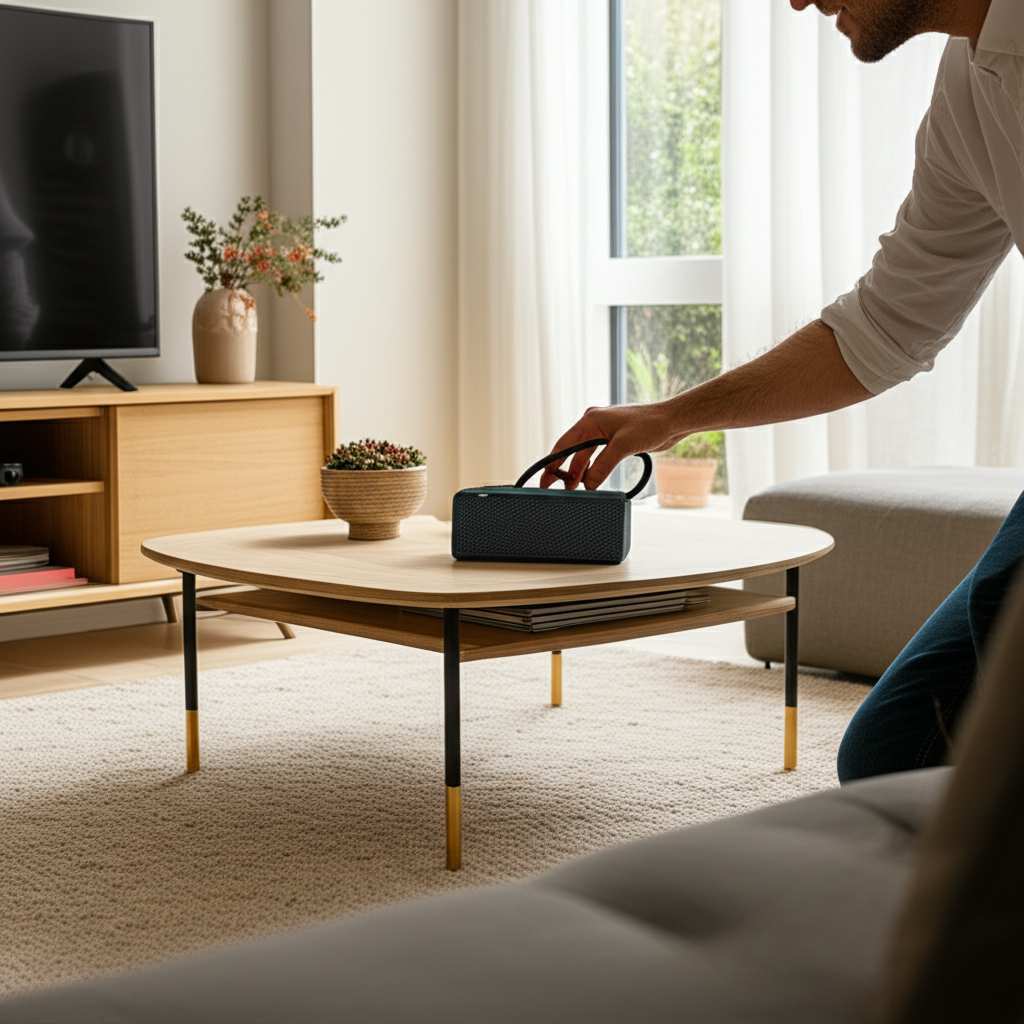
Think about it like this: a tiny speaker trying to fill a big living room is like trying to fill a bathtub with a teacup. It’s just not going to cut it. On the flip side, a gigantic speaker in a small apartment might sound like a concert hall gone wrong – way too much for the space. The goal is a good balance, where the speaker can handle the room without being overwhelming.
Let’s Talk About Sound: What Size Means for Audio Quality
When we talk about speaker size, we’re usually talking about the physical dimensions and, more importantly, the size of the speaker drivers inside. These drivers are the heart of the speaker. They come in different sizes, measured in inches or millimeters.
Smaller drivers, like those found in mini Bluetooth speakers, are great for portability and personal listening. They’re easy to carry around and don’t take up much space. However, they often struggle to reproduce deep bass notes and can sound a bit tinny when you turn up the volume.
Larger drivers, on the other hand, are a different story. They can create more powerful sound waves. This means you get a fuller, richer sound with better bass response. For a living room, where you might want to enjoy music, movies, or podcasts with more depth, larger drivers are usually a good bet. They can handle a wider range of frequencies, making everything sound more vibrant.
Finding Your Living Room Sweet Spot: Speaker Dimensions
Okay, so how big is “big enough” for a living room? It’s a bit of a spectrum! We can categorize Bluetooth speakers into a few general size groups:
Mini/Ultra-Portable Speakers
Typical Dimensions: Around 2-6 inches tall and 2-5 inches wide.
Sound: Best for personal listening or small spaces. Bass might be limited.
Living Room Use: Not ideal for filling a whole room with rich sound. Good as a secondary, portable option.
Compact/Medium Speakers
Typical Dimensions: Around 6-12 inches tall and 4-8 inches wide.
Sound: Offers a good balance of volume and clarity. Can handle moderate bass.
Living Room Use: A great starting point for many living rooms. Can fill a medium-sized space well.
Large/Bookshelf Speakers
Typical Dimensions: Around 12-20+ inches tall and 6-12+ inches wide.
Sound: Powerful, deep bass, and excellent clarity. Designed to fill larger spaces.
Living Room Use: Perfect for larger living rooms or for those who love a truly immersive audio experience.
Let’s look at some typical sizes and what they might offer.
| Speaker Size Category | Typical Width (inches) | Typical Height (inches) | Typical Depth (inches) | Best For |
|---|---|---|---|---|
| Mini/Ultra-Portable | 2 – 5 | 2 – 6 | 1 – 3 | Personal listening, small desks, travel |
| Compact/Medium | 4 – 8 | 6 – 12 | 3 – 6 | Small to medium living rooms, kitchens, offices |
| Large/Bookshelf | 6 – 12 | 12 – 20+ | 4 – 8 | Medium to large living rooms, home theaters |
See? A compact or medium speaker is often your best bet for a standard living room. It’s not too big, not too small. It can deliver enough sound to make your music enjoyable without making your neighbors complain too loudly.
What About Wattage? Does That Affect Size?
You’ll often see speakers advertised with a wattage number, like 20W or 50W. Wattage is a measure of power. Higher wattage generally means a louder speaker. While it’s not directly about physical size, there’s a connection.
To produce more powerful sound (higher wattage), speakers often need larger drivers and more robust internal components. So, a 50W speaker is likely to be physically larger than a 10W speaker. This larger size allows it to handle the power and produce a fuller sound.
Think of wattage as how much “oomph” the speaker has. For a living room, you probably want something with enough wattage to fill the space comfortably without distorting. For most medium-sized living rooms, speakers in the 20W to 60W range are a good starting point. Larger rooms might benefit from 60W or even higher.
Room Size: The Unsung Hero of Speaker Choice
This is super important! How big is your living room? Is it a cozy nook or a sprawling entertainment space? The size of your room is a huge factor in determining the ideal speaker size.
Small Living Room (e.g., apartment, smaller house): A compact or medium-sized speaker (think 6-10 inches tall) is usually perfect. It can provide enough volume and richness without overwhelming the space. A super-large speaker might sound boomy or distorted in a small area.
Medium Living Room (e.g., average family home): This is where a medium to large speaker (10-15 inches tall) shines. It has the power to fill the space with clear, dynamic sound. You’ll get a good balance of bass and treble.
Large Living Room (e.g., open-plan, high ceilings): You’ll want to lean towards the larger side of medium or even a full-on large bookshelf-style speaker (15+ inches tall). This ensures the sound can reach all corners of the room without sounding strained.
Don’t forget about acoustics, too! Hard surfaces like windows and bare walls can make sound bounce around, making it seem louder. Soft furnishings like carpets and curtains can absorb sound. This can influence how loud you need your speaker to be.
Key Features to Consider Beyond Size
While size is a big deal, it’s not the only thing that makes a Bluetooth speaker great for your living room. Here are a few other features that matter:
Driver Configuration: Some speakers have multiple drivers – a woofer for bass and a tweeter for treble. This leads to better sound separation and clarity.
Portability vs. Placement: Do you want to move it around, or will it have a dedicated spot? Larger speakers are less portable.
Battery Life: If you plan to use it away from an outlet, battery life is key. Larger speakers might have larger batteries, but they also use more power.
Connectivity: Most use Bluetooth, but some offer Wi-Fi for better streaming or multi-room audio.
Water Resistance: Probably not a huge concern for a living room, but good to know if you ever take it outside!
Stereo Pairing: Some speakers can pair with another identical speaker to create a true stereo sound experience, which is fantastic for living rooms.
Comparing Popular Living Room Bluetooth Speakers (Examples)
Let’s look at a couple of popular types of speakers and how their size might fit into a living room scenario. This isn’t an exhaustive list, but it gives you an idea!
Speaker Model (Example)
Approx. Dimensions (H x W x D)
Driver Size (Example)
Wattage (Example)
Ideal Living Room Size
JBL Charge 5
3.5 x 8.7 x 3.7 inches
2.75″ woofer, 0.75″ tweeter
40W
Small to Medium
Sonos Five
6.3 x 14.3 x 6 inches
3 mid-woofers, 3 tweeters
210W (total)
Medium to Large
Bose SoundLink Revolve+ II
7.5 x 4.1 x 4.1 inches
Single large transducer, dual passive radiators
Not officially stated, but powerful
Small to Medium
The Sonos Five, for example, is a larger speaker. It’s designed to fill a room with sound, making it great for a medium to large living room where you want a premium audio experience. The JBL Charge 5 is more compact, making it a good fit for smaller living rooms or if you also want some portability. The Bose SoundLink Revolve+ II aims for 360-degree sound and fits well in many living room sizes due to its balanced output.
This table shows how different sizes and power outputs cater to different room needs. A bigger speaker like the Sonos Five has more drivers and higher wattage, so it’s built for larger spaces. A smaller one like the JBL Charge 5 is more versatile.
How to Pick the Right Speaker for You
Okay, you’ve got the lowdown on size and wattage. Now, how do you actually choose? Here’s a simple checklist:
1.
Measure Your Living Room: Get a rough idea of its square footage. This is your most important clue!
2. Consider Your Listening Habits: Do you like background music or booming party tunes? Do you watch movies with surround sound in mind?
3. Think About Placement: Where will the speaker live? Near a wall? In a corner? This can affect bass response.
4. Set a Budget: Prices vary wildly. Bigger often means more expensive, but not always.
5. Read Reviews: See what actual users say about how a speaker performs in a living room setting. Sites like CNET and TechRadar often have great reviews.
6. Listen If You Can: If possible, try to hear the speaker in a similar environment.
It’s all about finding that sweet spot where the speaker’s power and size match your room’s dimensions and your personal preferences. You want a speaker that sounds good at normal listening volumes and can also get a bit louder when you want it to, without sounding strained or distorted.
Common Questions About Living Room Bluetooth Speakers
Let’s tackle some common questions beginners might have.
Q1: How important is the brand of a Bluetooth speaker for my living room?
A: Brand matters, but it’s not everything! Well-known brands often have a reputation for quality, research, and good customer support. They might have engineers who specialize in making speakers sound great. However, some smaller or newer brands also make fantastic speakers. It’s always good to check reviews for specific models, no matter the brand.
Q2: Can a small Bluetooth speaker sound good in a large living room?
A: A small speaker can play music in a large living room, but it might struggle to fill the space with rich, full sound. You might find yourself turning the volume up very high, which can lead to distortion. For a truly immersive experience in a large room, a larger speaker is generally recommended.
Q3: I see “360-degree sound” – does that mean size doesn’t matter?
A: “360-degree sound” means the speaker is designed to project audio in all directions, which is great for filling a room evenly. While this feature helps distribute sound, the overall power and driver size still play a role in how loud and how deep the bass can be. A small 360-degree speaker will still have limitations compared to a larger one.
Q4: What’s the difference between a portable Bluetooth speaker and a home speaker?
A: Portable Bluetooth speakers are designed for mobility – they usually have built-in batteries and are relatively compact and durable. Home speakers, even Bluetooth ones, are often designed for stationary use. They might be larger, require constant power, and prioritize sound quality and power over portability. For a living room, a home-focused Bluetooth speaker is often better.
Q5: Should I get one big speaker or two smaller ones for my living room?
A: This is a great question! One larger speaker can provide a powerful central sound source. However, two smaller speakers can be placed strategically to create a stereo effect, giving you a more defined left-right soundstage. This can make music and movies feel more immersive. If your living room is medium to large, two stereo-paired speakers can be fantastic.
Q6: How do I know if a speaker is too big for my living room?
A: If a speaker looks visually overpowering in the space, or if reviews mention it sounding “boomy,” “muddy,” or “distorted” at moderate volumes in smaller rooms, it might be too big. Generally, if you find yourself turning the volume down significantly to avoid being overwhelmed, it’s probably too large for optimal listening.
Q7: What does “frequency response” mean and is it related to size?
A:** Frequency response tells you the range of sounds a speaker can produce, from low bass to high treble (e.g., 50Hz – 20kHz). Larger speakers, with bigger drivers, are generally better at reproducing lower frequencies (bass). So, yes, size often plays a role in achieving a wider and more impactful frequency response, especially on the low end.
Making the Final Choice: Your Living Room, Your Sound
Choosing the right Bluetooth speaker size for your living room is all about finding that perfect harmony between your space, your listening habits, and the speaker’s capabilities. Don’t get bogged down by endless specs. Focus on what makes sense for your room.
A compact or medium-sized speaker is often the sweet spot for most living rooms, offering a great balance of volume, clarity, and bass. If you have a larger space or crave that cinema-like experience, lean towards a bigger, more powerful unit. Remember to check reviews and, if possible, listen before you buy.
You’ve got this! You now know that size matters because it influences how much air a speaker can move, which directly impacts sound quality and volume. You understand how wattage plays a role and how your room’s dimensions are crucial.
Now go forth and find that speaker that will make your music sing, your movies roar, and your podcasts crystal clear. Your living room is about to get a serious audio upgrade!